

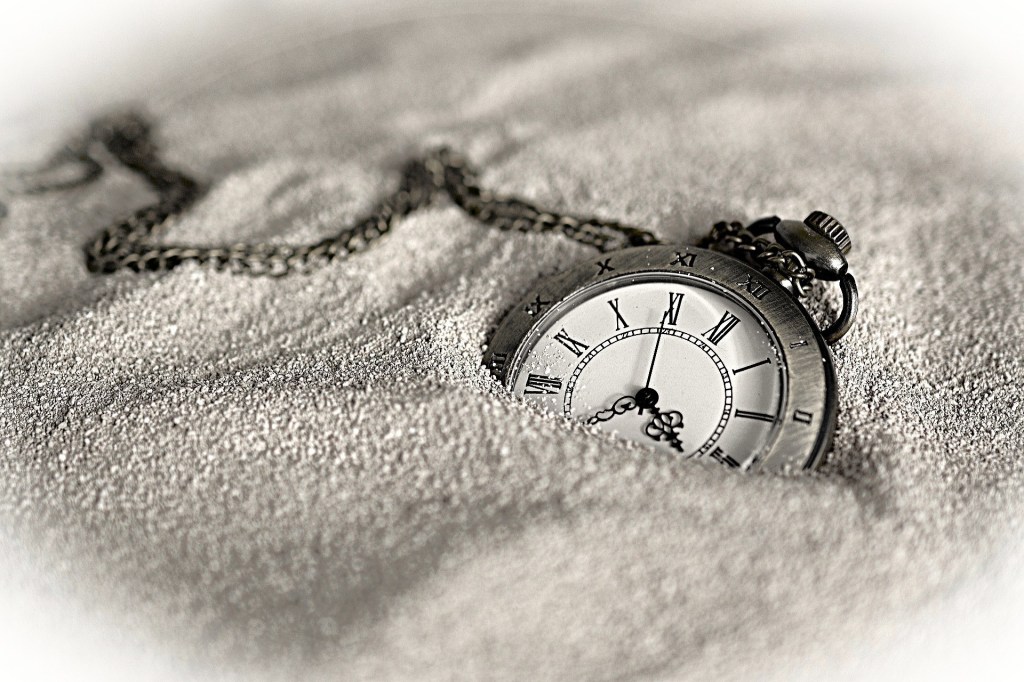
your relationship with a tick and a tock may say more about you than you know
The clock. It’s been, remains and will always be the biggest deal in your life, meaning from the cry of conception until that last breath: every second is a friend unless biology or the penal system, say otherwise. In fact, the span feels different with the words of a doctor falling from the sky, and it makes you think about the queue on death row where those seconds and minutes add weight to a wait. Clearly, the paths are different but the feeling from a point must be one and the same and unlike any other, with a corridor narrowing up to your shoulders. Squeezing you slightly with a touch of time, as a quagmire forms around your feet.
It’s the eternal race against in trying to make the most of what the gods gave you, while dealing with the slings and arrows of Shakespeare’s fortune. In fact, wrestling within as a lifetime slips out takes you to a reckoning in the form of an advert, first seen in your youth: or a song that came out before the internet gave birth to a world we’ve sown and struggle with now. So, that sentimentality can leave you stuck in a minefield of memories just waiting to go off as you rue the pages, in a journal.
As with all measurable things: the study of time grabs attention and for obvious reasons, making ‘Time use’ an area of research from basic survival, to the top of Maslow’s Hierarchy of Needs. So, it’s a type of calculation through daily diaries or activity lists that are relative, in recording a quality of life. Yet, that’s the difference between living or surviving or allocating time to fend off enemies and where hunger or danger is less time spent, on developing ideas and a cultural evolution.
This last point is important where the relativity of a subsistence mindset to physical and mental exploration has a massive impact, on time use. As the late David Landes, a professor in history and economics at Harvard University, wrote in his landmark book the ‘Wealth and Poverty of Nations’:
‘On a map of the world in terms of product or income per head, the rich countries lie in the temperate zones, particularly in the northern hemisphere; the poor countries, in the tropics and semitropics. As John Kenneth Galbraith put it when he was an agricultural economist: “[If] one marks off a belt a couple of thousand miles in width encircling the earth at the equator, one finds within it no developed countries. … Everywhere the standard of living is low and the span of human life is short.”’
It stands to reason, of course, that if fifty-percent or more of your day is spent trying to find food or water or simply safe shelter, your approach to time is different to those of us with easier lives. It’s a different type of mental health, too, where cortisol and adrenaline reign supreme under various forms of threat. As for any learning? How can it take place on an empty stomach, while even children in developed nations are facing this peril but then this is the thing about time. It doesn’t always measure slow-release mechanisms, taking months or years to show up.

In time-use studies then, care has been taken to develop uniformity across the world that supports relative measurement. For instance, the department of economic and social affairs at the United Nations released a set of time-use classifications in 2016, for this purpose:
Major Divisions
- Employment and relate activities
- Production of goods for own final use
- Unpaid domestic services for household and family members
- Unpaid caregiving services for household and family members
- Unpaid volunteer, trainee and other unpaid work
- Learning
- Socialising and communication, community participation and religious practice
- Culture, leisure, mass media and sports practices
- Self-care and maintenance
United Nations, International Classification of Activities for Time-use Statistics 2016, Page 17
Within each of these lie subdivisions, too, taking the total number of subcategories to fifty-six while the ‘Complete Classification’ list itself, is nothing short of extensive. Meanwhile, a 2015 study, called ‘Understanding time use: Daily or Weekly Data?’ describes the survey tool as:
‘Time use surveys (TUS) provide information on how populations – described in terms of variables such as gender, age, ethnicity, socioeconomic status and household type – assign their time to perform all types of activities.’
So, as a person, how is your relationship with time? Are you conscious of the clock and the at times insidious movement? What if, you procrastinate: isn’t time your arch nemesis? Well, it may depend on your culture and the nature of your mañana, meaning time is even more relative than Einstein’s beam of light. So, turning up late to a party, for example, is proverbially and fashionably late while not being seated for a family meal is annoyingly and typically wrong. It reflects priorities that could be seen as disrespectful and where late is simply late and a pattern is generally a pattern.
Arguably, though, one of the greatest remarks on the passing of time came from George Bernard Shaw when he said: ‘Youth is wasted on the young.’ In one fell swoop, he captured envy, regret and chronology. While Victor Hugo, the author of The Hunchback of Notre Dame, reminds us that ‘Forty is the old age of youth; fifty, the youth of old age’, which allows us to relive a little of the young-ish upstart.

Yet; for many of us, nothing sheds light on the transience of time or the fragility of mental health, like the technological revolution. You’d think so, because isn’t your mental health a reflection, in part, of social experiences based on challenges and micro-power struggles? In the 1970s, as with all decades before the information overthrow, you had to turn to the actual environment for influences on your mind. Having the newest possessions in the form of the latest car perhaps or a massive stone fireplace, put you in a particular bracket and made you feel a certain way. So, did the real social circles you inhabited or worse still, did not.
‘Don’t worry about the world coming to an end today. It’s already tomorrow, in Australia.’
Charles M. Schulz
Equally, it’s true to say that where young people nowadays have never waited ten minutes for a computer game to load only for it to crash and then repeat in the same way, for an hour: their definition of patience, draws quiet laughter. As does having no choice but to wait until the following week, for the next episode of a programme. So, time appears to have sped up if you’re past a certain age while at the same time, there are corners of the world where it continues on fairly still, if not quite having stopped.
It’s the most precious commodity we have and yet for so many it’s spent in the worst of conditions, that are too numerous to name. One should be mentioned, however, if only due to the sickening nature of what’s lost and it’s the wrongful conviction. Surely, there are few types of injustice more heart-breaking than spending thirty years of a life behind bars, for a crime you never committed. It beggars belief that’s even possible, and it may be the penultimate existential theft before life itself. Yes, the weight of lost time is extraordinary when we pass this way but once, and it raises one of the most compelling and eternal questions of all.
Why, for so many, is time so cheap?
‘Time is the ultimate limited resource. Every one of us has the same ‘time budget’ – 24-hours-per-day, 365-days-per-year, giving a total of 8,760 hours – each year of our lives.’
Time Use, Our World In Data
In the race for resources everything has a price, but the ticking of our clocks is the same regardless of how we look, sound or in fact, what we believe.
Copyright © 2024 | recoveryourwellbeing.com | All Rights Reserved
Images:
Sands of Time, by Ann Capicatures, Pixabay – Main Image
Submerged Seconds, by Engin Akyhurt, Pixabay
Grandfather to Grandson, by Pritam Kumar, Pexels
References:
Esteban Ortiz-Ospina, ‘Time Use’, Our World In Data, 2020, accessed 6th August 2024, https://ourworldindata.org/time-use
A.J Willingham, ‘What Is Maslow’s Hierarchy of Needs? A Psychology Theory, Explained’, CNN, 15th August 2023, Section 13, accessed 6th August 2024, https://edition.cnn.com/world/maslows-hierarchy-of-needs-explained-wellness-cec/index.html
Peter Reuell, ‘David S. Landes, 89, Dies’, The Harvard Gazette, 30th August 2013, accessed 6th August 2024, https://news.harvard.edu/gazette/story/2013/08/david-s-landes-89-dies/
David Landes, ‘Wealth and Poverty of Nations’ (London, Abacus Publishing, 1999), pp 5, Para 2, accessed 6th August 2024, https://www.amazon.co.uk/Wealth-Poverty-Nations-David-Landes/dp/0349111669/
Editorial, ‘Chronic Stress Puts Your Health at Risk’, Mayo Clinic, 1st August 2023, accessed 6th August 2024, https://www.mayoclinic.org/healthy-lifestyle/stress-management/in-depth/stress/art-20046037#:~:text=Adrenaline%20makes%20the%20heart%20beat,the%20body%20that%20repair%20tissues.
Sally Weale, ‘One in Four Teachers Gave Food to Hungry Pupils in England Last Term, Survey Finds’, The Guardian newspaper, 31st August 2023, accessed 6th August 2024, https://www.theguardian.com/education/2023/aug/31/teachers-gave-food-hungry-pupils-england-survey
United Nations, ‘International Classification of Activities for Time-use Statistics 2016’, Economica and Social Affairs, Statistics Division, ST/ESA/STAT/SER.M/98, Page 17, accessed 6th August 2024, https://unstats.un.org/unsd/gender/timeuse/23012019%20ICATUS.pdf
Sergio Jara-Diaz and Jorge Rosales-Sala, ‘Understanding Time Use: Daily or Weekly Data?’ Transportation Research Part A: Policy and Practice, Volume 76, 2015, Pages 38-57, ISSN 0965-8564, accessed 7th August 2024, Introduction, https://10.1016/j.tra.2014.07.009
‘Mañana’ definition, Cambridge Online Dictionary, Cambridge University Press & Assessment, 2024, accessed 7th August 2024, https://dictionary.cambridge.org/dictionary/english/manana
Walter Isaacson, ‘The Light Beam Rider’, The New York Times, Opinion, 30th October 2015, accessed 7th August 2024, https://www.nytimes.com/2015/11/01/opinion/sunday/the-light-beam-rider.html
Bio, ‘George Bernard Shaw’, Britannica, 22nd July 2024, accessed 7th August 2024, https://www.britannica.com/biography/George-Bernard-Shaw
George Bernard Shaw Quote, ‘Youth is wasted…’ BrainyQuote, 2024, accessed 7th August 2024, https://www.britannica.com/biography/George-Bernard-Shaw
Bio, ‘Victor Hugo’, Britannica, 26th July 2024, accessed 7th August 2024, https://www.britannica.com/biography/Victor-Hugo
Victor Hugo, ‘The Hunchback of Notre Dame’ (London, Penguin Classics, 1978) Revised Ed, https://www.amazon.co.uk/Notre-Dame-Paris-Classics-Victor-Hugo/dp/0140443533/
Victor Hugo Quote, ‘Forty is the old age of youth…’ BrainyQuote, 2024, accessed 7th August 2024, https://www.brainyquote.com/quotes/victor_hugo_103906
‘Life in 1970s Britain’, Bush Green Theatre, 24th April 2015, accessed 7th August 2024, https://www.bushtheatre.co.uk/bushgreen/life-in-1970s-britain/
Charles M. Schulz Quote – ‘Don’t worry about the world…’, Brainy Quote, 2024, accessed 7th August 2024, https://www.brainyquote.com/quotes/charles_m_schulz_189865
‘Treasures of Unknown Spain in Castilla y Leon’, España, Spain’s Official Tourism Website, 2024, accessed 7th August 2024, https://www.spain.info/en/discover-spain/beautiful-villages-castilla-leon-inland-spain/
National Registry of Exonerations, ‘2022 Annual Report’ 8th May 2022, accessed 7th August 2024, https://www.law.umich.edu/special/exoneration/Documents/NRE%20Annual%20Report%202022.pdf
Dale Carnegiq Quote, ‘I shall pass this way but once…’ Goodreads, 2024, accessed 7th August 2024, https://www.goodreads.com/quotes/1207674-i-shall-pass-this-way-but-once-any-good-therefore#:~:text=I%20shall%20pass%20this%20way%20but%20once%3B%20any%20good%2C%20therefore,not%20pass%20this%20way%20again.
Esteban Ortiz-Ospina, et al, ‘Time Use’ Our World In Data, February 2024, Para 1, accessed 7th August 2024, https://ourworldindata.org/time-use

 recover your wellbeing