


quarterly appraisals aren’t enough for our three score years and ten
Beyond a certain age, it seems strange perhaps for twenty-five years to have passed since the turn of the century. One moment, we were preparing to celebrate a once-in-a-lifetime event while fearing the collapse of technology, on the turn of a digital date. The next, the world had changed in ways previously thought impossible. From the horrors of 9/11 to new types of U.S president and the near collapse of a financial system: the first two decades of the 21st Century were as stunning as they were contradictory. As ever, of course, and in reduced terms, we were left to get on with our daily lives and where a path for each in a particular direction left questions over what might have been.
This opportunity cost as it’s known in economics is part of the way we live, making regret inevitable and negotiation possible as we make sense of it all. Of course, the way we reach decisions means looking into connections while judging a pay off and the commitment, which is a fairly fast calculation. Multiply this and we’re jostling for position in everything from work and relationships, to health and the unknown. Yet, do we know what we’re doing when we come to a junction or worse still a crossroads?
‘It is change, continuing change, inevitable change, that is the dominant factor in society today. No sensible decision can be made any longer without taking into account not only the world as it is, but the world as it will be.’
Isaac Asimov
Decision Theory, as you’d imagine, covers everything imaginable within a framework of utility, consent, rationality and conditionals that, in turn, reveal the motives behind your thinking. Thoughts that should be clear in their meaning and objectives and with as much background information as possible, as you weigh up the utility or overall value of your options.
‘Expected Utility Theory is based on the assumption that the choices of a rational decision maker aim at achieving the largest value of an expected ‘utility.’ Since the utility actually generated by a choice depends also on contingencies on which the decision maker has no control (the “state of nature”), the decision makers choice is guided by his ideas about the likelihood of the state of nature at the time of making a decision.’
Ezio Biglieri, Dimensions of Uncertainty in Communications Engineering

It’s true and when it comes to choosing with levels of uncertainty, Blaise Pascal’s famous wager is a good example of the variables. The French philosopher and mathematician said the question of your belief in God’s existence and what we’d call an afterlife, can be resolved with what we’d now call Game Theory. With parallels to the ‘Prisoner Dilemma’, the basic premise says: in being unable to rationally prove the existence of God, it’s best to hedge your bets and believe; so, that if it’s true, you win. If you don’t believe and it’s true, then you suffer according to your religious beliefs. If you believe and it’s not true, then at least you’ve lived a life with spiritual values and if you don’t believe and it’s not true, then you’ve lost nothing, at all. Obviously, as you choose, there’s a clash between genuine faith in a higher power and a tactical fear of divine retribution.
For many, a higher power sits in the value of stock markets where fortunes are won and naturally lost in the back and forth of trade while it’s there that waves of uncertainty, keep threatening the global economy. It’s the simplest equation of human anxiety with complexity beyond our reckoning, leaving hope, expectation and portfolios of investment on edge most of the time. So, with conflicts and climate ravaging stability, and the cost of living destroying household incomes, we’re forced to gamble any feelings of optimism while turning away from prediction. In fact, when it comes to all aspects of health, the pervasive and debilitating nature of uncertainty might be the number one issue.
It can lead to learned helplessness and depression while spanning the spectrum, in full. For a long time, too, it was thought to be exactly that, learned, but research from 2015 now suggests a default mechanism, during chronic adversity. Whatever the route, it’s possibly an unseen factor in people’s thinking when it comes to mental health and especially after years of attempted recovery have failed. In line with that, a critical aspect is the loss of motivation to try and change outcomes even with potential success which is similar, to elements of depression. Even so, studies also suggest that we’re capable of altering this cognitive-based, state of mind.
Well, the mind can do almost anything, but learned helplessness presents in various ways from impotency in abusive relationships to combating a health issue while a very modern take lies in media anxiety, a new and well-recognised source of imbalance. It’s no surprise with the world we live in, demanding attention 24/7 on apps, channels and other platforms and where exposure to life’s negativity has grown exponentially. The impact of this has been enormous with studies carried out, to measure the effects.
‘In this media environment, [Professor] Stosny described the smartphone as a sort of drug delivery system, incessantly delivering news and other information. Research has demonstrated that a phone alert spurs a small release of dopamine. A powerful motivator, he said. “Your phone buzzes, and you are going to reach for it, [even] if you are hanging by one arm from a cliff.’
Charlotte Huff, American Psychological Association, quoting Steven Sosny, Ph.D, relationship therapist and author
That ties in with the idea of rational choice where if your brain’s motivation-reward system is telling you to check your phone and you do, you’re now acting with logical consistency, regarding self-interest. The fact that it may lead to a deeper sense of helplessness about the world around you seems less important: until that is, self-interest means filtering the saturation. Still, a fear of uncertainty is built into us as other evidence points towards a rise in poor mental health over many decades and before the ubiquity of smartphones and social media. Yet, the basic issue is that while young people deal with the same angst their parents and uncles and aunts faced, factors of time and space have altered dramatically. Where before you had to leave the front door to face the bullies, now, you can do it while lying in bed. Where the safety gap of 48-hours across a weekend afforded some type of reprieve from school, now, it’s inescapable.
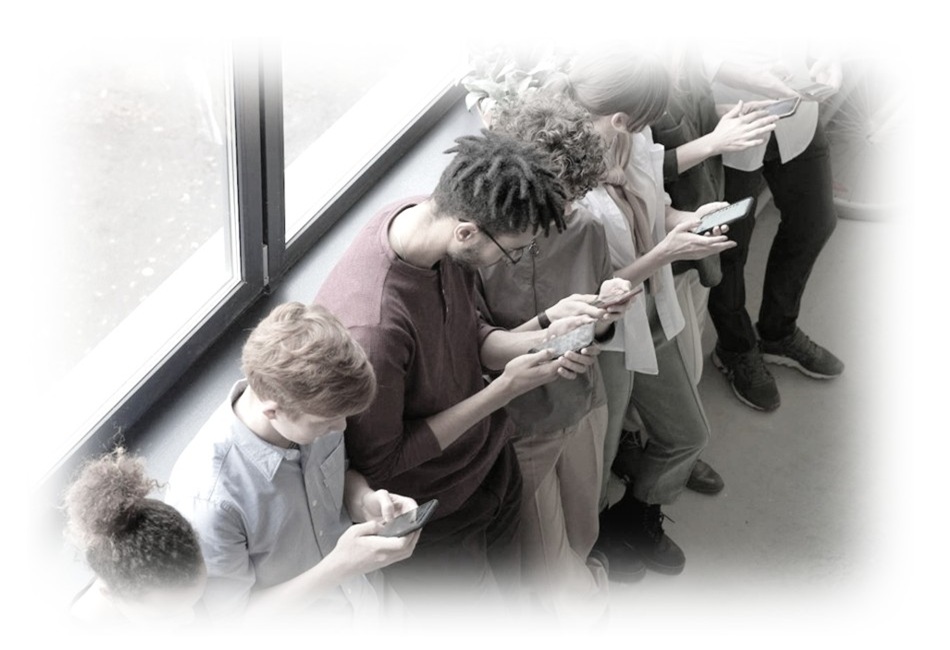
A 2017 article, by the Harvard Graduate School of Education, revealed something about these modern-day struggles through the results of a 2015 Pew study, on ‘social-media induced stressors’:
- Seeing people posting events to which you haven’t been invited
- Feeling pressure to post positive and attractive content about yourself
- Feeling pressure to get comments and likes on your posts
- Having someone post things about you that you cannot change or control
In addition to this, Leah Shafer listed ‘Feeling replaceable’; ‘Too much information’; ‘Digital FOMO (Fear Of Missing Out)’ and ‘Attachment to actual devices’, as factors, too. Yet, with the exception of the last one, the rest were all present in the 70s and 80s but the intensity and frequency have changed. In fact, in 2018, the UK’s The Independent newspaper reported that: ‘Children are being exposed to “significant emotional risk” on social media, particularly as they transition into secondary school.’ The then timely report, led by the former Children’s Commissioner for England, Ann Longfield, said that the way children see themselves through social media: affects their self-image and subsequent self-esteem.
Well, in spite of it all, we’re like moths to a flame because having said all this, the internet is the greatest encyclopedia anyone could wish for and to the point that it would take several lifetimes, to read it in its entirety. To illustrate, The Washington Post gave a non-scientific estimation of the number of pages a printed internet would occupy and the figure was an astounding, 47 billion.
‘Smartphones and social media expand our universe. We can connect with others or collect information easier and faster than ever.’
Daniel Goleman
So, it means we have agency with caveats that are human, but another study in 2023 looked at ties between uncertainty and mental health while drawing links, from 101 papers. It’s of no surprise where uncertainty is existential by definition and the stress involved, can affect your biology. For instance, the unknown can trigger fight, flight or freeze as the idea of pain, loss or worst of all, death, releases a flood of neurochemicals, to make good an escape. In fact, with the adrenal glands, hypothalamus and amygdala in full operation, the least of your priorities will be learning facts: making listening and cognitive functioning, more difficult.
Of course, anxiety and worrying news have always been around but the rate of delivery is unprecedented, and it would be interesting to see the picture in a hundred years time. Will we have adapted with ease and what will the deluge itself, look like?
Well, as you look into the impact of anything on a group, the behaviour of people as individuals is just as important for whatever it tells you and a very old and interesting depiction, lies in the front cover of Thomas Hobbes’ ‘Leviathan‘. Written as the devastation of the English Civil War raged between 1642-51, he grimly assessed the nature of violence and ways to contain it, with the engraved cover showing a sovereign king composed of individual subjects. Like many people at the time, he was deeply affected by what he saw as families and friends turned on each other with uncertainty over who could be trusted. These days, as citizens in distant countries, the human race continues to witness conflict which few might deny has led to elements of a desensitised world. A changed socioeconomic world in which a telecoms revolution led by radio, television and then computers made such dualities possible.

In a book, called: ‘The Spectatorship of Suffering’, Lilie Chouliaraki, a professor of Media and Communication at the London School of Economics, discusses the phenomenon of ‘Media Witnessing’, in which our screen-side seats deliver us from suffering.
‘What I seek to study is the choices made when creating the news text concerning how the sufferer is portrayed on screen and how the scene of suffering is narrated. Even though such choices are part of everyday journalistic routines rather than ideologically motivated calculations, they always carry norms as to how the spectator should relate to the sufferer and what we should do about the suffering. It is these ethical values, embedded in news discourse, that come to orientate the spectator’s attitude towards the distant sufferer and, in the long-run, shape the disposition of television publics vis-à-vis the misfortune of far away others.’
It seems so, and as she ends with the idea that feelings of pity are the opposite to what’s needed if a global audience is to understand a separation between the suffering of others and our own pain: it speaks to modern life where a scaled-up channelling of emotions, is the norm. That lament may be a reflection on our ever-present fear of uncertainty, too. So, much so that we often look to things bigger than ourselves as we search for meaning within suffering which is easier, depending on which side of the screen you’re on. Still, it offers a way to cope with the tensions of being human:
‘In our view, any approach to human suffering must account for both the darker and lighter side of the human experience, and we must posit that one must fully address the harsh existential realities that each person must address while simultaneously working towards sustainable flourishing for individuals, groups and societies.’
‘An Existential Positive Psychology Model of Suffering‘ Para 5
Well, some live with more uncertainty than others and that’s just how it is and, yes, the world will change over the next twenty-five, too. So, as people, as citizens try and process their lives, the choices we make can only affect each other as each day is a reminder of what the pandemic laid bare. We’re all invested when it comes to the value of health and as the days, weeks and months tick by, life pushes us to find a strategy to deal with inevitable uncertainty. A plan for the elements and where the opportunity cost of choice leaves your health in better condition as opposed to worse and where the supply and demand of emotional goods is balanced, to the best of your abilities.
So much of life is beyond our control, making the fear of uncertainty certain.
Copyright © 2025 | recoveryourwellbeing.com | All Rights Reserved
Images:
Reading the Papers, by Wal_172619, Pixabay – Main Image
Which Way Now? by Shauking, Pixabay
Conversation Killer, by Fauxels, Pexels
Late Night Viewing, by Cottonbro, Pexels
Kim Rutledge, et al, ‘Y2K Bug’, National Geographic, Education, 6thg December 2024, accessed 23rd January 2025, https://education.nationalgeographic.org/resource/Y2K-bug/
‘Opportunity Cost’, International Institute for Educational Planning, UNESCO, 2025, accessed 23rd January 2025, https://policytoolbox.iiep.unesco.org/glossary/opportunity-cost/
Isaac Asimov Quote – ‘It is change, continuing change…’, Brainy Quote, 2025, accessed 23rd January 2025, https://www.brainyquote.com/quotes/isaac_asimov_124394?src=t_decision
Weirich, Paul, ‘Decision Theory’, Oxford Bibliographies, 7th September 2022, doi: 10.1093/OBO/9780195396577-0207. Accessed 23rd January 2025, https://www.oxfordbibliographies.com/display/document/obo-9780195396577/obo-9780195396577-0207.xml
Cooper, W.S, ‘Decision Theory as a branch of Evolutionary Theory: A Biological Derivation of the Savage Axioms’, Psychological Review, 94(4), 395-411, 1987, https://doi.org/10.1037/0033-295X.94.4.395, https://psycnet.apa.org/record/1988-12548-001
‘Rationality’, Cambridge Dictionary Online, 2025, accessed 23rd January 2025, https://dictionary.cambridge.org/dictionary/english/rationality
‘Consent’, Cambridge Dictionary Online, 2025, accessed 23rd January 2025, https://dictionary.cambridge.org/dictionary/english/consent
Investopedia Team, ‘Utility in Economics Explained: Types and Measurement’, Investopedia, Reviewed by Robert C. Kelly, Fact-checked by Vikki Velasquez, 25th June 2024, accessed 23rd January 2025, https://www.investopedia.com/terms/u/utility.asp
‘Conditional’, Cambridge Dictionary Online, 2025, accessed 23rd January 2025, https://dictionary.cambridge.org/dictionary/english/conditional
Ezio Bigleri, ‘Dimensions of Uncertainty in Communications Engineering’, Science Direct, 2022, Abstract, accessed 23rd January 2025, https://www.sciencedirect.com/topics/computer-science/expected-utility-theory
The Editors of Encyclopaedia Britannica, ‘Pascal’s Wager’, Britannica Online, Revised and updated by Melissa Petruzzello, 2025, accessed 23rd January 2025, https://www.britannica.com/topic/Pascals-wager
Editorial, ‘Game Theory Explained’, American Experience, WGBH Educational Foundation, 2025, Para 7, accessed 24th January 2025, https://www.pbs.org/wgbh/americanexperience/features/nash-game/
Editorial, ‘The Prisoner Dilemma’, American Experience, WGBH Educational Foundation, 2025, Para 8, accessed 24th January 2025, https://www.pbs.org/wgbh/americanexperience/features/nash-game/
Mario Catalán, et al, ‘How High Economic Uncertainty May Threaten Global Financial Stability’, International Monetary Fund, IMF, 15th October 2024, accessed 24th January 2025, https://www.imf.org/en/Blogs/Articles/2024/10/15/how-high-economic-uncertainty-may-threaten-global-financial-stability
Shayla Love, ‘Fear of the Unknown: Are You More Sensitive to Uncertainty Than Others?’ The Guardian newspaper, 9th April 2024, https://www.theguardian.com/wellness/2024/apr/09/uncertainty-mental-health
Morgan T.A, ‘Learned Helplessness’, In: Gellman, M.D., Turner, J.R. (eds) Encyclopedia of Behavioural Medicine, Springer, New York, NY, https://doi.org/10.1007/978-1-4419-1005-9_1201, https://link.springer.com/referenceworkentry/10.1007/978-1-4419-1005-9_1201#citeas
Maier S.F & Seligman M.E, ‘Learned Helplessness at Fifty: Insights from Neuroscience’, Psychol Rev, 2016, Jul;123(4):349-67, doi: 10.1037/rev0000033, PMID: 27337390; PMCID: PMC4920136, https://pmc.ncbi.nlm.nih.gov/articles/PMC4920136/
Lauren B. Alloy, ‘On the Cognitive Component of Learned Helplessness and Depression’, Psychology of Learning and Motivation, Academic Press, Volume 13, 1979, Pages 219-279, ISSN: 0079-7421, ISBN: 9780125433136, https://www.sciencedirect.com/science/article/abs/pii/S0079742108600845
Zia Sherrell, ‘How to Manage Political Anxiety’ Medical News Today, Medically reviewed by Bethany Juby, 26th September 2024, accessed 23rd January 2025, https://www.medicalnewstoday.com/articles/political-anxiety
Charlotte Huff, ‘Media Overload is Hurting our Mental Health. Here Are Ways to Manage Headline Stress’, American Psychological Association, Vol. 53, No.8, 1st November 2022, Para 28, accessed 23rd January 2025, https://www.apa.org/monitor/2022/11/strain-media-overload
Rachel Schraer, ‘Is Young People’s Mental Health Getting Worse?’ BBC News, 11th February 2019, accessed 23rd January 2025, https://www.bbc.com/news/health-47133338
Roland Paulson, ‘Young People Were Becoming More Anxious Long Before Social Media – Here’s The Evidence’, The Conversation, 19th November 2024, accessed 24th January 2025, https://theconversation.com/young-people-were-becoming-more-anxious-long-before-social-media-heres-the-evidence-243738
Leah Shafer, ‘Social Media and Teen Anxiety’, Harvard Graduate School of Education, President and Felows of Harvard College, 15th December 2017, accessed 24th January 2025, https://www.gse.harvard.edu/ideas/usable-knowledge/17/12/social-media-and-teen-anxiety
May Bulman, ”Children Facing Significant Emotional Risk on Social Media”, The Independent Newspaper, 4th January 2018, accessed 24th January 2025, https://www.independent.co.uk/news/uk/home-news/facebook-children-risk-emotional-impact-report-warning-a8140526.html
Caitlin Dewey, ‘If You Could Print Out The Whole Internet, How Many Pages Would It Be?’ The Washington Post, 18th May 2015, accessed 24th January 2025, https://www.washingtonpost.com/news/the-intersect/wp/2015/05/18/if-you-could-print-out-the-whole-internet-how-many-pages-would-it-be/
Massazza A, et al, ‘The Association Between Uncertainty and Mental Health: A Scoping Review of the Quantitative Literature, J Ment Health, 2023, Apr;32(2):480491, doi: 10.1080/09638237.2021.2022620. Epub 2022 Jan 11, PMID: 35014927, https://pubmed.ncbi.nlm.nih.gov/35014927/
Dr Radha Modgil, ‘How The Neuroscience of Uncertainty Can Help You Make Better Decisions’, BBC Science Focus Magazine, 26th January 2023, accessed 24th January 2025, https://www.sciencefocus.com/news/neuroscience-uncertainty-better-decisions
‘Adrenal glands’, John Hopkins Medicine, The John Hopkins University, 2025, accessed 24th January 2025, https://www.hopkinsmedicine.org/health/conditions-and-diseases/adrenal-glands#:~:text=What%20You%20Need%20to%20Know,stress%20and%20other%20essential%20functions.
‘Hypothalamus’, John Hopkins Medicine, The John Hopkins University, 2025, accessed 24th January 2025, https://www.hopkinsmedicine.org/health/wellness-and-prevention/anatomy-of-the-endocrine-system#:~:text=%EF%BB%BFThe%20hypothalamus%20secretes%20hormones,the%20middle%20of%20the%20brain.
‘Amygdala’, John Hopkins Medicine, The John Hopkins University, 2025, accessed 24th January 2025, https://www.hopkinsmedicine.org/health/conditions-and-diseases/anatomy-of-the-brain
Thomas Hobbes, ‘Leviathan’ (London, Penguin Classics, 2017) https://www.amazon.co.uk/Leviathan-Penguin-Classics-Thomas-Hobbes/dp/0141395095/
Editorial, ‘English Civil Wars’, History Channel, History.com Editors, 2nd December 2009, accessed 23rd January 2025, https://www.history.com/topics/european-history/english-civil-wars
Lilie Chouliaraki, ‘The Spectatorship of Suffering’, The London School of Economics and Political Science, January 2006, doi: 10.4135/9781446220658, accessed 17th February 2024, https://www.researchgate.net/publication/30522921_The_Spectatorship_of_Suffering
Kyriakidou, M, ‘Media Witnessing: Exploring the Audience of Distant suffering’, Media, Culture and Society, 37(2), 215-231, https://doi.org/10.1177/0163443714557981
P. Frosh & A. Pinchevski (Eds), ‘Media Witnessing: Testimony in the Age of Mass Communication’ (London, Palgrave Macmillan, 2008)
Daryl R. Van Tongeren & Sara A. Showalter Van Yongeren, ‘Finding Meaning Amidst COVID-19: An Existential Positive Psychology Model of Suffering’, Personality and Social Psychology, 10th March 2021, Vol 12, https://doi.org/1o.3389/fpsyg.2021.641747

 recover your wellbeing