
boxers are some of the best strategists but chasing shadows is another matter
Life plays many roles simultaneously as it puts you on the canvas at times while reeling off the proverbial countdown, with an outstretched finger. At the same time, you might be wrapped in a swirling battle with yourself as the pressure to succeed pushes you blindly into testing others, with all the tactics of rivalry. Either way, the floor is where you’ll be if and when the fuel of your motivation runs out, but it’s about that overused word ‘authenticity,’ and the relationship you build with the truth, on all levels. It also concerns ghosts of the past impacting the present as they and you, in turn, threaten your future.
It’s such a feature of life, that if you take a number of Tom Cruise’s films, you’ll find him competing with a phantom parent, mostly a father, as he wrestles his dignity alongside the problem at hand. Of course, he’s a good actor and whether he’s behind the wheel of a racing car, a fighter-jet, a cocktail bar or a defence attorney’s desk, the spectre of failure haunts him like the mythical Sword of Damacles. As a result, in Vanilla Sky; Top Gun; Days of Thunder; A Few Good Men; Rain Man and Collaterol, we see the heavy shadow of an older man, while Cocktail reverses the pattern with a mother. It’s an interesting archetype that doesn’t have to be and isn’t always familial; so, what does it mean exactly to compete with yourself as well as others?

Well, to begin with, it surely lies with the ego: a concept of Freud’s that whilst modified and updated in many respects, remains valid today as a representation of our working minds. So, where in simple terms, the Superego is the moral compass in our thinking as it sits in contrast to the Id, the wanton and unbridled animal within: the Ego is the arbiter of both as it tests reality against their wishes and scripts. Yet, all too often, our ego can turn into the worst enemy possible and no more so than when it comes to being competitive.
‘A recent study may help us to understand why we underscore different achievement to stoke our own egos, and seek other types of validation. Researchers suggest that when we feel threatened in one arena, such as our professional roles, we seek to restore our standing in another arena, in a move called a ‘status pivot’. It’s a possible coping mechanism for vulnerability or inadequacy.’
Aysha Imtiaz and Bryan Lufkin, Features Correspondents, BBC News website
So, reality isn’t always a friend, and we’ll most likely do whatever it takes to hide from whatever the world is trying to tell us. If it’s recognising that we’re not quite as good as the next person be it a friend, a colleague or a stranger: the hackles may rise as our definition of success slaps us in the face, hard if not harder. In trying to then reconcile the unacceptable even if it involves a family member, we may fall into the trap of appeasing the ego at the expense of another which may lead, of course, to all kinds of damage. Clearly, that internal squaring of a circle rests on your ability to process the existential nature of competing because in real terms, losing the race for promotion at work or at the finishing line on a track reflects a sense of self that may, in the end, lift or sink you.
Yet, while it may feel like life and some sort of death in those moments, existentialism’s focus on self-improvement and that word again, authenticity, drives the possibility of a different type of bargain. One that acknowledges how the competitive urge is multi-faceted where at once we’re essentially saying no to our perceived and established limitations but with an essential clarity, allowing us to stay in our own lane, to coin a phrase, as we focus on real or convincing deficits. It’s not easy in a world where interacting with others is a necessary part of our experience, and Jean Paul Sartre, one of the great exponents of existentialism, spoke of the complex interplay:
‘We do not encounter reasons for believing in the Other’s existence, but we encounter the Other and would offer as much natural resistance to solipsism as we would offer to doubts of our own existence. This means that while I cannot prove the fact that the very being of my consciousness is affected by another consciousness, I do in fact experience it.‘
‘The connecting link here is the body. When I “exist” my body in the process of achieving my usual relations with objects in the world, this is my “body-for-me.” But the body has two other dimensions as well. There is the body-for-the-Other and the “body-seen-by-the-Other.”‘
Jean Paul Sartre, Being and Nothingness, 1943

Here, he seems to be saying that our existence is inherently rivalrous as it merges with a competitive basis to life, by definition of seeing (the Other) and being seen (by the Other) and how we react, accordingly. From there, it’s a short leap towards machinations that may or may not be Machiavellian in our attempts to establish superiority over others, and if that’s the goal, they usually are unless bounded by the rules found in sport and other areas. Of course, even they can be bent and in turn, it leads to a simple question regarding: what kind of environment is created? For many, perhaps, the answer of ‘cut-throat’ brings joy to the heart as a means to an end involving power, influence and money. For others, it’s a version of hell as the cost of a soul defined by integrity seems too much to pay, for the sake of adulation.
It’s an interesting question, too, because level playing fields are designed to test who and what we’re really about, meaning if we ‘stack the deck’ or ‘rig the game’, we’re basically admitting that we may not have what it takes, in the first place. Ironically, often in full view of those we’re trying to convince, as well, but the fact that we can’t see or won’t admit it, highlights the intensity of competing. If and when we take that to another level in trying to sabotage others, we’ll cross a rubicon and possibly a relationship of sorts as we’re left with two repeating questions. Firstly, why not draw inspiration from other people’s hard work and their victories, too? Then, secondly, what are you willing to sacrifice internally and externally as you bitterly re-assess your skills, strengths and weaknesses and all for the sake of a win? Jealousy, envy, rage and plotting may get you far but in what sense?
On the other side of that coin, it’s the domino effect where the negative things we absorb in the wake of someone else’s insecurities are passed on, if we’re not careful, and therein lies the vying. The inability to accept that there’s always somebody objectively bigger, faster, healthier or wealthier or subjectively, happier, cleverer, funnier or more physically appealing: is a weight, drowning an ego. Of course, you invariably end up losing sight of your own dreams and goals when the clearest thing on the horizon is somebody else’s progress. So, beyond low self-esteem and the need for external validation what else is driving the hyper-competitive nature of some individuals?
‘Some people appear to be motivated by competition, whereas others are not. We hypothesized that people who are motivated by competition are motivated for at least three reasons: competition allows them to satisfy the need to win, competition provides the opportunity or reason for improving their performance, and competition motivates them to to put forth greater effort that can result in higher levels of performance.’
Robert E. Franken & Douglas J. Brown, ‘Personality and Individual Differences’ journal, 1995
These are three very different reasons that aren’t mutually exclusive and for obvious reasons in embodying ambition, motivation and the process. So, having looked at one approach to aspiration, it’s important to examine others.

Winning seems like one of the easiest things to quantify and understand because when we not only excel at something but do it in a way that leaves others behind us, the biological rewards are as intriguing as they are well-documented. Take, for instance, a research study carried out, in 1989. Brian Gladue, Michael Boechler and Kevin McCaul performed an interesting experiment regarding testosterone and cortisol levels in people who thought they were winning at something, in contrast to those who believed they were losing. With saliva tests taken intermittently, hormonal changes reflected the participant’s perceptions of status while at the same time, certain parameters included ‘Close-contest Conditions’ and ‘Decisive Conditions’.
‘Winners had higher overall TE levels than losers in both conditions. Mood was depressed in Decisive losers compared to all other groups. The results indicate that the perception of winning or losing differentially influenced TE levels and that such hormonal changes are not simply general arousal effects but are related to mood and status change.’
Hormonal Response to Competition in Males, Aggressive Behaviour Journal, 1989
While this shows the chemical changes influencing the outcome of a game, match or any type of contest, the biological rewards of winning centre on dopamine, with noradrenaline flooding the brains of people on the losing side. Naturally, we’d prefer the former as we chase the external reality of a medal, cup or position and those motivators are forever powerful as we compete against others, in what is hopefully a fair event.
Meanwhile, where ‘competition provides the opportunity or reason for improving their performance’, it speaks to a different sort of motivation perhaps, in which someone’s personal drive or agent causation isn’t enough to bring about change, in their development. As a result, the pressure of a competition can instil a sense of dread that in turn pushes someone into action. In contrast, if ‘competition motivates them to put forth greater effort that can result in higher levels of performance’, it could mean that the process itself means as much as the outcome. In line with that, there are numerous articles online discussing ways to enjoy the process, and it’s valuable advice reminding us that journeys are easier if we’re in tune with the demands.
‘I always say my biggest competitor is myself because whenever I step out there on the mat, I’m competing with myself to prove that I can do this and that I am very well trained, prepared for it.’
Simone Biles, Artistic Gymnast and 11 Olympic and 30 World Championship medals winner
It’s true, where self-competing can draw the best from you as a person and in particular: honest appraisals of mistakes, strategies and solutions, offering improvement at any level. This always involves some sort of measurement, too, be it time; distance or distance over time; power; accuracy; balance or psychological processing. It may well be weight loss; promotion or the ratios in romance. Whatever it is, only absolute self-honesty will let you advance and anything else is just letting you down. So, set your targets and hit them, but if you miss, do it again because you have one of two choices. You can either lose valuable hours of your life to rationalisation or you can accept the failure, no matter what, and pick up where you left off. In fact, it plays to your advantage where as the saying goes: ‘growth occurs at the point of stress’. Of course it does, while building resilience, analytical thinking and crucially, reference points. With that in mind, make it – self-competing – the grit in your grin as you push yourself further, with everything you’ve got.

So, what does the word ‘competition’ actually mean for you, and how does it make you feel?
Does it bring back memories of school and of being made to squirm as others mocked a relative physical or cognitive weakness? Or, is it a reminder of being picked first or second in playground games and or getting A-grades, most if not all of the time? Either way, it may have left a lasting legacy in the way you see competition that in turn, dominates your thinking, words, actions and reactions. Well, instead of imploding under the weight of those things, start rewarding yourself, instead, for minor achievements. Maybe, it’s the way you speak to yourself that suddenly feels nicer or perhaps, exercising some empathy where you’d normally look for an opening. Regardless, if you’re able to treat your life with a real sense of self-respect: who cares what others are achieving unless, of course, you’re officially competing.
‘Even though running is work for me, I always miss it if I take a break. A lot of people find running relaxing [too], but I can never switch off from timing and competing against myself.’
Sir Mo Farah, former long-distance runner and Olympic gold medallist
‘Becoming the best version of yourself’ is another well-worn phrase that’s also disliked by some because of the implied pressure. It’s a valid point for those who feel comfortable with their lives, but if you’re someone who wants to explore your capabilities, there’s nothing wrong with it, at all. In fact, there’s no point in judging either direction just as no one-size fits all.
Copyright © 2025 | recoveryourwellbeing.com | All Rights Reserved
Images:
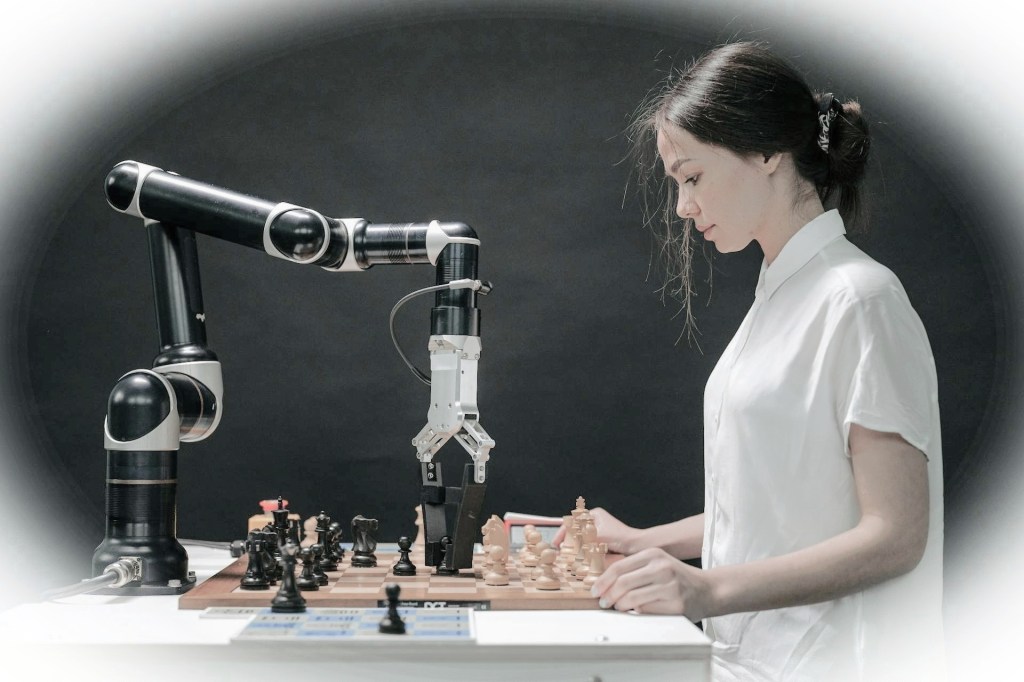
Chess Queen, by Pavel Danilyuk, Pexels – Main Image
Inside the Mind, by Tylijura, Pexels
Other Existence, by Sasha Zilov, Pexels
Game Face, by Football Wife, Pexels
Not For Me, by Jupilu, Pixabay
‘The Sword of Damacles’, Fables of the World – See U in History, Youtube, 14th April 2022, accessed 28th June 2025, https://www.youtube.com/watch?v=xp5O7NpaLtg
‘Archetype’, American Psychological Association, 2025, accessed 28th June 2025, https://dictionary.apa.org/archetype
‘The Freudian Theory of Personality’, Journal Psyche & Authors, 1994-2025, Paras 12, 13 & 14, accessed 28th June 2025, https://journalpsyche.org/the-freudian-theory-of-personality/
Quote – Aysha Imtiaz and Bryan Lufkin, ‘How We ‘Satus Pivot’ in Ego-threatening Situations’, BBC News website, 4th November 2021, Para 3, accessed 28th June 2025, https://www.bbc.com/worklife/article/20211102-are-competitive-parents-compensating-for-their-insecurities
Quote – Jean Paul Sartre, ‘Being and Nothingness: The Principal Text of Modern Existentialism’ (1992, Simon and Schuster, London) Translator’s Introduction, pp.xlix, https://www.google.es/books/edition/Being_and_Nothingness/L6igUcpDEO8C?hl=es&gbpv=1&dq=Being+and+Nothingness:+A+Phenomenological+Essay+on+Ontology&printsec=frontcover
Jacob Saliba, ‘Sartre on the Body in “Being and Nothingness”, Epoché Philosophy Magazine, Issue 41, June 2021, Para 5, The Ontological Dimensions of the Body, accessed 29th June 2025, https://epochemagazine.org/41/sartre-on-the-body-in-being-and-nothingness/
Quote – Robert E. Franken and Douglas J. Brown, ‘Why Do Some people Like Competition? The Motivation for Winning, Putting Forth Effort, Improving One’s Performance, Performing Well, Being Instrumental and Expressing Forceful/Aggressive Behaviour’, Personality and Individual Differences, Volume 19, Issue 2, 1995, Pages 175-184, ISSN 0191-8869, https://doi.org/10.1016/0191-8869(95)00035-5, Abstract, accessed 29th June 2025, https://www.sciencedirect.com/science/article/abs/pii/0191886995000355
Quote – Gladue, B.A., Boechler, M. and McCaul, K.D, ‘Hormonal Response to Competition in Human Males’, Aggressive Behaviour, Volume 15, Issue 6, pp. 409-422, 1989, https://doi.org/10.1002/1098-2337(1989)15:6˂409::AID-AB2480150602˃3.0.CO;2-P, Abstract, accessed 29th June 2025, https://psycnet.apa.org/record/1990-14082-001
‘Dopamine: The Pathway to Pleasure’, Harvard Health Publishing, Harvard Medical School, 2025, accessed 29th June 2025, https://www.health.harvard.edu/mind-and-mood/dopamine-the-pathway-to-pleasure
‘What is Noradrenaline?’ Mental Health America, 2025, accessed 29th June 2025, https://mhanational.org/resources/what-is-noradrenaline/
‘Agent-causation’, Oxford Reference Online Dictionary, Oxford University Press, 2025, accessed 29th June 2025, https://www.oxfordreference.com/display/10.1093/oi/authority.20110803095355816?rskey=J0XANV&result=4
Drew Dinan, ‘Enjoy the Process’, Ultra Running Magazine, 24th February 2020, accessed 29th June 2025, https://ultrarunning.com/featured/enjoy-the-process/
Quote – Simone Biles, ‘I always say my biggest competitor…’ Brainy Quote, 2025, accessed 29th June 2025, https://www.brainyquote.com/quotes/simone_biles_771456?src=t_competing
Quote – Sir Mo Farah, ‘Even though running is work for me…’, Brainy Quote, 2025, accessed 29th June 2025, https://www.brainyquote.com/quotes/mo_farah_810722

 recover your wellbeing