


the additive nature of knowledge is a constant lesson in growth
We’ve all experienced life lessons in one form or another and most probably from an early age, too. It may have been your hand in the heat of the proverbial flame, iron or hob. Or, maybe it was the screeching of tyres and the shock of a car horn as you lost one of your cat lives. No matter the form, it left a mark reminding you never to do it again as accumulating incidents boosted your attendance at the school of life’s hard knocks. We call it survival or beating the odds and the more we accrue in the way of our history, the greater our chances of reaching an end; yet, how does it work in fine detail and can knowing help us to manage a little better?
The question has been asked in various ways from the advice given in a GP’s surgery to the Society of Clinical Psychology in the U.S asking: would you feel better or worse after being given a biological explanation for your [mental health] disorder? It’s been asked in the context of education as well and where the late James Zull, a former professor of biology at Cape Western Reserve University, Ohio, USA, published a book in 2002, called ‘The Art of Changing the Brain’. In it, he said:
‘Along the way [in writing the book] I drew courage from people like [Gerald] Edelman and [George] Lakoff, who have argued powerfully for a biological understanding of cognition and learning. I heard them affirm what I believe, which is that all the products of the mind come from the brain and its interactions with the body and the world. As a biologist, I think I understand Edelman better, and I was especially compelled by his insistence that we must recognise the biological origins of the brain in evolution and in development, if we are to understand the human mind and heart.’
It takes us to the elemental in asking further questions, like: ‘So, what happens to our cells, as we learn?’ Well, whether in the brain or the body, change occurs everywhere as our cells respond to environmental stimuli and research has now shown that memories are retained across the human body and in a variety of cells. Of greater surprise, perhaps, are the results emerging from the field of quantum biology where our physiological processes are seen to be directed by the non-mythical spin of electrons which aren’t actually spinning but rather descriptive in their qualities. In fact, the mind-boggling dimensional properties of electron spin are as complex as they seem beautiful.
So, just what is happening to our cells as we take in new information constantly, and what theories have emerged through the physical, emotional, economic and sociological spheres we inhabit?
Movement, as we all know by now, is the short answer to the first question. Vectoring activity as neurons wriggle and grow, stretch and change direction in an effort to form connections with a vast array of 80-100 billion others, in the brain. An astonishing network with electrochemical impulses operating at speed while as we repeat an action or respond to internal or external stimuli again and again, the connections strengthen to form long-term arrangements. Reflecting this, an old adage in neuroscientific circles, says:
‘Cells that fire together, wire together.’
Donald Hebb, Canadian neuropsychologist and author of Hebbian theory
It’s deceptively simple in its description of a process that begins with the growth of some 250,000-brain-cells-a-minute, during pregnancy; yet, as we gradually undertake the learning that carries us through a lifetime, those numbers reach a staggering 100-trillion by some estimates. This constant change is called neuroplasticity and it looks like our experience of adaptation comes down to a handful of seconds and milliseconds, to be precise. Just, 20 of them. How? Well, before answering perhaps we need to look at two things regarding action potentials, AP, and depolarisation.
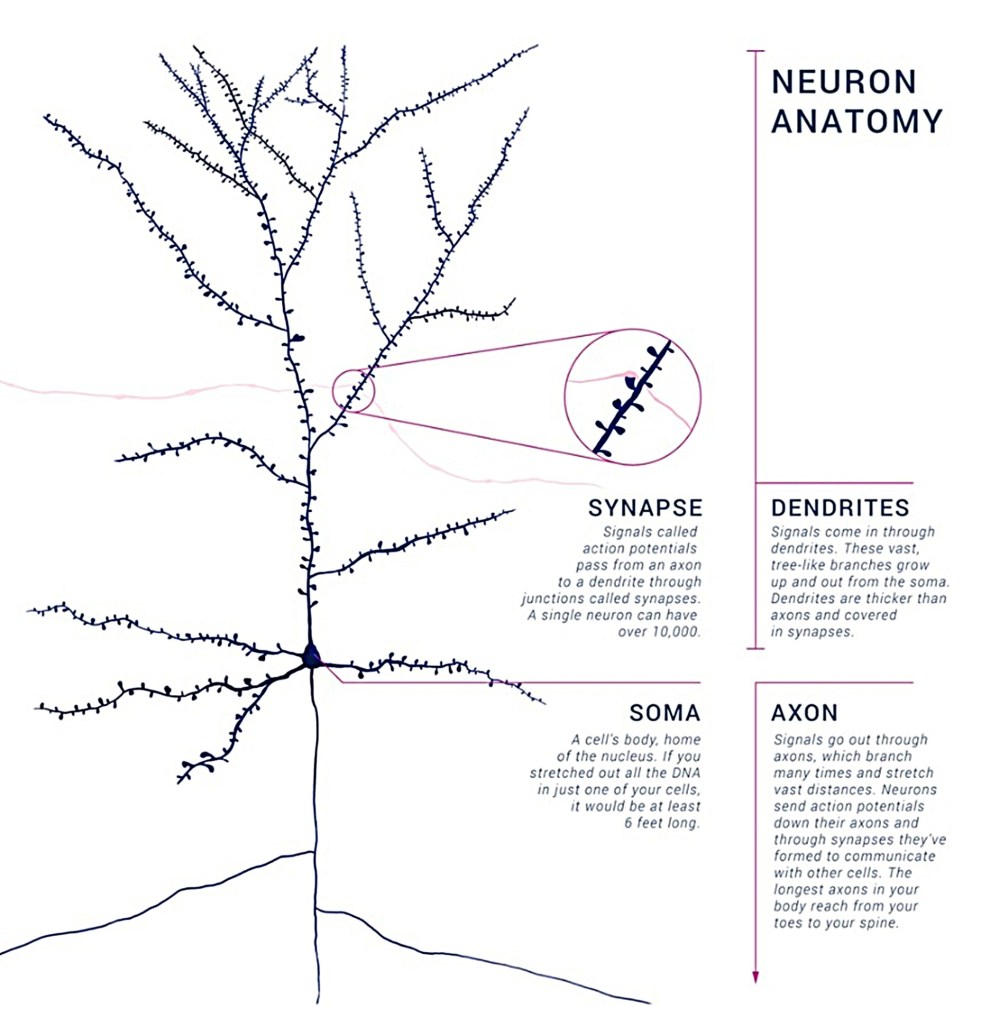
In simple terms, an AP is like a courier with lightning quick feet as it prepares to explode off the mark. Before doing so, it takes a deep breath to change its energy potential before releasing it to carry a message along the axon from one end of a neuron to the other and in order to pass on electrochemical signals. On route, further ‘breaths’ are taken to reinforce the potential but in real terms and using sodium, potassium and calcium amongst others: the polarities (or electrical ‘push’ or ‘pull’ changes) within and between neurons switch to create energy allowing neurotransmitters, to move around smoothly. In fact, when we think of neurons ‘firing’, it’s the action potential we’re referring to.
So, when it comes to the formal learning that we begin at school, these writhing, darting axons help to steer us in various directions as we develop skills and abilities that in turn have bearing on a future economic status. Scaled up, it means we’ll adopt one or more of the many theories around education that inform policies and initiatives and their implementation around the world. These ideas, for instance, have shaped the way we approach children in particular and their absorption and retention of knowledge, as well as a lifelong ability to create and innovate.
‘I like to listen. I have learned a great deal from listening carefully. Most people never listen.’
Ernest Hemingway
In line with this, there are five main theories of learning that have evolved through decades of discussion. The Behaviourist learning theory to begin with, states that learning and behaviour are driven by external forces as they interact with our internal mechanisms. In other words, learning is the environment and vice versa, which in itself touches on other ideas from the notion of ‘tabula rasa’ or the blank slate that is supposedly a new-born baby to the internal processes of schematic theory as old beliefs are constantly updated. In turn, behavioural expression lies in the stimulus-response of classical conditioning and the positive and negative (addition or removal) of a reinforcement or punishment, in operant conditioning. Notable proponents include, B.F Skinner and J.B Watson.
This is a basic experience of everyday life as we go about our business where in seeking pleasure as we avoid pain, we’ll compromise our relationships instead of compromising within them, and inflict damage rather than take it. On the one hand, it’s fundamental to survival, of course, but only in the short-term because on the other, the long-term pitfalls of the ‘pinball’ effect ricochet through society as ‘hurt people, hurt people,’ every day.

Cognitive learning theory, meanwhile, was influenced by Jean Piaget, a Swiss psychologist whose ideas about learning and the acquisition of knowledge in stages by children shaped the growing direction of developmental psychology. This approach also focuses on memory, attention and problem-solving amongst things while delivering a framework built on the cellular and molecular processes underpinning every other theory. At the same time, it underlines the importance of encouraging students of any age to review and reflect on whatever they’re learning which takes us back to the idea developed by Donald Hebb in: cells that fire together, wire together.
‘Tell me and I forget. Teach me and I remember. Involve me and I learn.’
Benjamin Franklin
For all areas and stages of education, the greatest barrier to learning is arguably trauma and emotional trauma in this particular context, which is in no way an overstatement. Why? Because the impact on your processing at cellular levels can be catastrophic and no more so than if your stress is prolonged and or chronic. So, by one route, it’s the overload on your neuron’s receptors (the protein molecules on a neuron’s receiving surface that allows binding to the neurotransmitters sent by those lightning quick, change-in-potential couriers) that leads to trouble. So, where the hormone glucocorticoid is released during chronic stress, it impacts glutamate levels that in turn flood the receptors with too much calcium in a process called excitotoxicity. The resulting cell death has been linked to a range of cognitive disorders, decline and disease. Alongside that, shrinking white matter and a hardening of anxiety pathways all contribute to a state of emergency where your learning is concerned.
‘Elevated cortisol levels can lead to neurodegenerative changes in the brain. Cortisol, acting through its glucocorticoid receptors affects neuronal growth and differentiation. Prolonged exposure to high cortisol levels is associated with neuronal atrophy, particularly in the hippocampus which is crucial for learning and memory. This atrophy is believed to result from cortisol-induced excitotoxicity and oxidative stress.’
Aleksander Sic, et al, Neurobiological Implications of Chronic Stress and Metabolic Dysfunction
Fortunately, nothing is fixed and what we call neuroplasticity allows us to change and repair the effects of the past and the present. In fact, as Dr Richard Davidson, a professor of psychology and psychiatry at the University of Wisconsin-Madison says, in a 2019 Ted Talk: our brains can begin the process of change within hours of altered behaviour. Of course and as he adds, sustained changes are needed to embed any long-term rewiring but the fact that we can initiate something new and almost immediately is a priceless gift of learning.
The constructivist theory of learning is as it says on the tin, so to speak, a layering of knowledge on what already exists. It places your personal, social and cultural history at the centre of any learning as emphasised by one of its leading thinkers, Lev Vygotsky, who also considered that placing a knowledge trellis around a student until they reach a position of confidence, works best. In addition, his belief in the four elementary mental functions of: attention, sensation, perception and memory being present at birth before being moulded by the environment sits in contrast to Piaget’s developmental theory. In a further contribution, he suggested that any evolution of the functions occurs in the gap between assisted and independent acquisition, which he then called the ‘Zone of Proximal Development’.

So, in learning a subject like mathematics, for example, it’s impossible to understand certain topics like quadratics without prior knowledge of algebra, making it both additive and constructivist. The latter term has meaning well beyond the simple in that constructive proofs relate to providing real examples of a mathematical form, before proving that it exists. In education, it means allowing students to build their own knowledge base in a way that has meaning to them personally, with the core concept of scaffolding applied by a teacher until a learner is confident enough to reproduce whatever it is by themselves. Key to this, is raising the bar regularly enough so that students remain in a state of adaptation throughout the zone of proximal development.
Connectivism looks at the social dynamics of learning and how the people we interact with help to develop a personal body of knowledge that we’ll add to, cement or subtract from as we go through life. Also, in drawing links between different sorts and sources of evidence we’ll form a network of best practise while filtering external information through the lens of compare and contrast. This interdisciplinary path helps to create a well-rounded view of life. Devised by George Siemens and Stephen Downes, it also concerns the idea that the type of knowledge you accrue is as valuable as the process itself, making evaluation alongside technology a key component of the theory. Of course, as with so many areas of knowledge it has its share of detractors, too:
‘Critics of connectivism as a learning theory, including Bell (2010), referred to connectivism as an instructional theory, not a learning theory. An instructional theory is a conceptual framework based on empirical findings and grounded in learning theories, which recommends the design of learning materials, resources, or situations to help learners achieve their learning outcomes and maximise their learning potential.’
Connectivism: 21st Century’s New Learning Theory, Dorothy C. Kropf
An old proverb attributed to Africa says that: ‘It takes a village to raise a child’, and the inherent connectivism reverberates around the world because where cultures are different, the essence of being human and all it entails is a shared experience. So, as a child grows and learns from people around them: any addition, cementing or subtraction of knowledge is a communal process in service of survival and whether in school, at home or somewhere else, the investment is a social advantage at an individual and group level. Of course, nowadays, the connections are global with anyone from anywhere offering input into other people’s growth and for better or worse, depending on your position. So, the diversity of knowledge so central to connectivism is a coin with two sides that may or may not be helpful but in truth, it’s up to each and every one of us to choose precisely whatever it is we want to believe in.

Finally, the humanist approach to learning places the existential presence of a student at the centre of everything, meaning your emotional development and personal growth are as important as the acquisition of knowledge. Pioneered mainly by Abraham Maslow and Carl Rogers and with differing approaches, humanism also uses free-will and choice as platforms for learning while varying in form across schools, colleges and other organisations. In the face of challenges to its methodology, though, Maslow himself was at pains to ensure that his words were scrutinised while recognising that the path towards acceptance would be long and arduous. Part of the reason for this was because humanistic learning often supports a loose type of curriculum in which the student-centred ethos leans into individual choices over subject matter and self-evaluation. It’s often seen as a zero-sum scenario when in fact, in confluent terms within the theory, it can be an adjunct to the established set of subjects as the two unite to produce the best outcome anyway.
‘It doesn’t matter what subject you teach, differences in students performance are affected by how much they engage in deliberate practice. Researchers who have investigated expert and novice performance have uncovered important distinctions between deliberate practice and other activities, such as play or repetition.’
Mary Brabeck, et al, Practice For Knowledge Acquisition, APA
Overall, it’s often the case that educators find themselves using all of the theories at one point or another and within the space of an hour, meaning as with the nature-nurture debate, there is no one size fits all. From the incentivisation in behaviour theory and positive reinforcement to ensuring that a learning environment is calm and conducive for cognitive function; to scaffolding the work for a learner in a constructivist way or the interdisciplinary connections that compare and contrast the world around us, the tools are there to be used. Meanwhile, tying it all in to the emotional and personal development of a learner is fundamental to the definition of education because as students make links in real time to their experiences or those of people they know, the bar raises itself and there can be no better incentive for everyone.
Copyright © 2025 | recoveryourwellbeing.com | All Rights Reserved
Images:
Neurogenesis, by Read Learn Grow 14, Youtube, 29th March 2017
Neuron Anatomy, by WikiImages, published under the Creative Commons Attribution-Share Alike 4.0 International license.
Hurt People, Hurt People, by Mikhail Nilov, Pexels
Numbers, Numbers, by Olly, Pexels
Classroom Joy, by Lalge Cain, Pexels
Kate MacDuffie and Tim Strauman, ‘Do Beliefs About Biology Matter for Mental Health?’, Society of Clinical Psychology, American Psychological Association, 2024, accessed 16th August 2025, https://div12.org/do-beliefs-about-biology-matter-for-mental-health/
Quote – James Zull ‘The Art of Changing the Brain’ (London, Routledge, 2002) accessed 16th August 2025, Chapter 1, Page 4, Para 2, https://www.amazon.co.uk/Art-Changing-Brain-Enriching-Exploring/dp/1579220541/
Javier Yanes, ‘Memory Is Not Exclusive To The Brain: Non-neural Cells Also Remember’, El Pais newsaper, Neuroscience, 3rd January 2025, accessed 16th August 2025, https://english.elpais.com/science-tech/2025-01-03/memory-is-not-exclusive-to-the-brain-non-neural-cells-also-remember.html
Cristina M. Alberini, ‘Not Just Neurons: The Diverse Cellular Landscape of Learning and Memory’, Neuron, Volume 113, Issue 11, 2025, Pages 1664-1679, ISSN 0896-6273, Summary, accessed 16th August 2025, https://www.sciencedirect.com/science/article/abs/pii/S0896627325003526
Johnjoe McFadden and Jim Alkhalili, ‘The Origins of Quantum Biology’, The Royal Society, 12th December 2018, Abstract & Introduction, accessed 17th September 2025, https://royalsocietypublishing.org/doi/10.1098/rspa.2018.0674
Clarice D. Aiello, ‘Quantum Physics Proposes A New Way To Study Biology – And The Results Could Revolutionize Our Understanding of How Life Works’, The Conversation, 15th May 2023, Para 12, accessed 17th September 2025, https://theconversation.com/quantum-physics-proposes-a-new-way-to-study-biology-and-the-results-could-revolutionize-our-understanding-of-how-life-works-204995
Eugene Khutoryansky, ‘Quantum Spin – Visualising The Physics and Mathematics’, Physics Videos by Eugene Khutoryansky, Youtube, 29th June 2019, accessed 17th September 2025, https://www.youtube.com/watch?v=3k5IWlVdMbo
‘Donald O Hebb’, Bio, Canadian Medical Hall of Fame, 2024, accessed 17th September 2025, https://www.cdnmedhall.ca/laureates/donaldhebb
Dong Il Choi & Bong-Kiun Kaang, ‘Interrogating Structural Plasticity Among Synaptic Engrams’, Science Direct, Current Opinion in Neurobiology, 2022, accessed 17th September 2025, https://www.sciencedirect.com/topics/neuroscience/hebbian-theory#:~:text=In%201949%2C%20Donald%20Hebb%20proposed,activated%20together%20during%20memory%20recall.
250,000 neurons – Ackerman S, ‘Discovering The Brain’ (Washinngton D.C, National Acadamies Press, 1992), Chapter 6, The Development and Shaping of the Brain, accessed 17th September 2025, https://www.ncbi.nlm.nih.gov/books/NBK234146/
100,000-trillion neurons – Ackerman S, ‘Discovering The Brain’ (Washinngton D.C, National Acadamies Press, 1992), Chapter 6, The Development and Shaping of the Brain, accessed 17th September 2025, https://www.ncbi.nlm.nih.gov/books/NBK234146/
Carl Sagan Quote – ‘The brain is like a muscle…’, Brainy Quote, 2024, accessed 17th September 2025, https://www.brainyquote.com/quotes/carl_sagan_125868?src=t_brain
Editors of Encyclopaedia Britannica, ‘Action Potential’, 7th November 2024, accessed 17th September 2025, https://www.britannica.com/science/action-potential
Editors of Encyclopaedia Britannica, ‘Depolarisation’, 7th November 2024, accessed 17th September 2025, https://www.britannica.com/science/nervous-system/The-neuronal-membrane#ref606371
‘Axons: The Cable Transmissions of Neurons’, University of Queensland, 2024, accessed 17th September 2025, https://qbi.uq.edu.au/brain/brain-anatomy/axons-cable-transmission-neurons
Diane A. Kelly, ‘Sending Information: Synapses and Neurotransmission’, BrainFacts.org, Society For Neuroscience, 30th November 2022, accessd 17th September 2025, https://www.brainfacts.org/brain-anatomy-and-function/cells-and-circuits/2022/synapses-and-neurotransmission-113022
Quote – ‘I like to listen…’, Ernest Hemingway, Brainy Quote, 2025, acessed 20th September 2025, https://www.brainyquote.com/quotes/ernest_hemingway_101588?src=t_learning
Gandhi MH and Mukherji P, ‘Learning Theories’, [Updated 2023 Jul 17], In: StatPearls [Internet], Treasure Island (FL): StatPearls Publishing; 2025 Jan-, Available from https://www.ncbi.nlm.nih.gov/books/NBK562189/
Andrew Reimann, ‘Behaviourist Learning Theory: Approaches and Methods in English for Speakers of Other languages’, The TESOL Encyclopedia of English Language Teaching (eds J.I Liontas, T. International Association and M. DelliCarpin) Wiley Online Library, 18th January 2018, https://doi.org/10.1002/9781118784235.eelt0155, https://onlinelibrary.wiley.com/doi/abs/10.1002/9781118784235.eelt0155
‘Tabula Rasa’, American Dictionary of Psychology, 19th April 2018, accessed 18th September 2025, https://dictionary.apa.org/tabula-rasa
Jeff Pankin,’Schema Theory and Concept Formation’, Massachusetts Institute of Technology, MIT Information Services and Technology, 2013, accessed 18th September 2025, https://web.mit.edu/pankin/www/Schema_Theory_and_Concept_Formation.pdf
Classical Conditioning – Peggy Andover, ‘The Difference Between Classical and Operant Conditioning’, Ted-Ed, 7th March 2013, accessed 18th September 2025, https://www.youtube.com/watch?v=H6LEcM0E0io
Operant Conditioning – Peggy Andover, ‘The Difference Between Classical and Operant Conditioning’, Ted-Ed, 7th March 2013, accessed 18th September 2025, https://www.youtube.com/watch?v=H6LEcM0E0io
‘Cognitivism’, Cardiff Metrpolitan University, Last Updated – 15th September 2025, accessed 18th September 2025, https://library.cardiffmet.ac.uk/learning/learning_theories/cognitivism
‘Piaget’s Theory of Cognitive Development’, Sprouts, Youtube, 1st August 2018, accessed 18th September 2025, https://www.youtube.com/watch?v=IhcgYgx7aAA
Quote – ‘Tell me and I forget…’, Benjamin Franklin, Brainy Quote, 2025, acessed 18th September 2025, https://www.brainyquote.com/quotes/benjamin_franklin_383997?src=t_learning
Hubert R. Dinse, et al, ‘The Stress Hormone Cortisol Blocks Perpetual Learning in Humans, Psychoneuroendocrinology’, Volume 77, 2017, Pages 63-67, ISSN 0306-4530, https://doi.org/10.1016/j.psyneuen.2016.12.002, https://www.sciencedirect.com/science/article/pii/S0306453016305315
Popoli M, et al, ‘The Stressed Synapse: The Imapct of Stress and Glucocorticoids on Glutamate Transmission’, Nat Rev Neurosci, 2011, Nov 30; 13(1):22-37, doi: 10.1038/nm3138, PMID: 22127301; PMCID: PMC3645314, https://pmc.ncbi.nlm.nih.gov/articles/PMC3645314/
‘Excitotoxicity Hypothesis’, ALS Insights, Youtube, 26th March 2025, 0:02 sec to 00:52 secs, accessed 20th September 2025, https://www.youtube.com/watch?v=0OSjfgNi8wA
Christopher Bergland, ‘Chronic Stress Can Damage Brain Structure and Connectivity’, Psychology Today, Reviewed by Ekua Hagan, 12th February 2014, Para 7, accessed 20th September 2025, https://www.psychologytoday.com/us/blog/the-athletes-way/201402/chronic-stress-can-damage-brain-structure-and-connectivity
Christopher Bergland, ‘Chronic Stress Can Damage Brain Structure and Connectivity’, Psychology Today, Reviewed by Ekua Hagan, 12th February 2014, Para 8, accessed 20th September 2025, https://www.psychologytoday.com/us/blog/the-athletes-way/201402/chronic-stress-can-damage-brain-structure-and-connectivity
Quote – ‘Elevated cortisol levels…’ Aleksander Sic, et al, ‘Neurobiological Implications of Chronic Stress and Metabolic Dysregulation in Inflammatory Bowel Diseases’, Diseases 12, No.9: 220, 18th September 2024, https://doi.org/10.3390/diseases12090220, Section 8. Neurobiological Implications, Para 2, accessed 20th September 2025, https://www.mdpi.com/2079-9721/12/9/220
Parisa Gazerani, ‘The Neuroplastic Brain: Current Breakthroughs and Emerging Frontiers’, Brain Research, Volume 1858, 2025, 149643, ISSN 0006-8993, https://doi.org/10.1016/j.brainres.2025.149643, https://www.sciencedirect.com/science/article/pii/S0006899325002021
Richard J. Davidson, ‘How Mindfulness Changes The Emotional Life of Our Brains’, TEDx Talks, TEDxSan Francisco, Youtube, 12th December 2019, 13 mins, 55 secs, accessed 20th September 2025, https://youtu.be/7CBfCW67xT8?si=lh55xVmioYJVKNkV&t=835
‘What Is Constructivism’, PHILO-notes, Youtube, 2nd September 2020, acessed 18th September 2025, https://www.youtube.com/watch?v=6Y2sU18vWb4
‘Vygotsky’s Theory of Cognitive Development in Social Relationships’, Sprouts, Youtube, 28th February 2025, accessed 18th September 2025, https://www.youtube.com/watch?v=8I2hrSRbmHE
Elsa Billings and Aida Walqui, ‘The Zone of Proximal Development: An Affirmative Perspective in Teaching ELLs and MLs’, New York State Education Department, 5th January 2021, accessed 18th September 2025, https://www.nysed.gov/bilingual-ed/topic-brief-4-zone-proximal-development-affirmative-perspective-teaching-ells-and-mls
Maarten McKubre_Jordens, ‘Constructivist Mathematics’, Internet Encyclopedia of Philosophy, 2025, accessed 20th September 2025, https://iep.utm.edu/constructive-mathematics/
‘Scaffolding’, The Bell Foundation, Resource Library, EAL Strategies & Great Ideas, 2025, accessed 20th September 2025, https://www.bell-foundation.org.uk/resources/great-ideas/scaffolding/
George Siemens and Gráinne Conole, ‘Special Issue – Connectivism: Design and Delivery of Social Networked Learning’, Editorial, The International Review of Research in Open and Distributed Learning, Vol. 12, Issue 3, March 2011, Para 1, accessed 19th September 2025, https://www.researchgate.net/publication/50888824_Special_Issue_-_Connectivism_Design_and_Delivery_of_Social_Networked_Learning
‘Connectivism – A Learning Theory’, Zolzaya Sh, Youtube, 3rd July 2020, 1 min, 29 secs, accessed 19th September 2025, https://www.youtube.com/watch?v=SvhY70C6Drk
‘Connectivism’, Brandy Dudas, Youtube, 23rd April 2016, accessed 19th September 2025, https://www.youtube.com/watch?v=a8kqcs2aR9c
Quote – Dorothy C. Kropf, ‘Connectivism: 21st Century’s New Learning Theory’, European Journal of Open, Distance and e-Learning, Vol. 16/No.2/24/ISSN 1027-5207, 2013, Page 15, accessed 19th September 2025, https://files.eric.ed.gov/fulltext/EJ1017519.pdf
Frances Bell, ‘Connectivism: Its Place In Theory-informed Research and Innovation in Technology-enabled Learning’, The International Review of Research in Open and Distributed Learning (12)3, doi: 10.10.19713/irodi.v1213.902, March 2011, Page 100, Para 4, accessed 19th September 2025, https://www.researchgate.net/publication/50888830_Connectivism_Its_Place_in_Theory-Informed_Research_and_Innovation_in_Technology-Enabled_Learning
Katherine Hill, ‘It Takes A Village To Raise A Child’, HuffPost, 30th September 2017, accessed 20th September 2025, https://www.huffingtonpost.co.uk/katharine-hill/it-takes-a-village-to-rai-3_b_12261128.html
Xiangkui, Z, ‘Humanistic Learning Theory’, In: Kan, Z (eds) The ECPH Encyclopedia of Psychology, Springer, Singapore, 2024, accessed 19th September 2025, https://link.springer.com/rwe/10.1007/978-981-97-7874-4_1089
Feigenbaum, K.D, ‘A Critique of Abraham Maslow and Carl Rogers as Educators’, Journal of Humanistic Psychology, 2023, 64(1), 44-63, https://doi.org/10.1177/00221678231154819, accessed 19th September 2025, https://journals.sagepub.com/doi/full/10.1177/00221678231154819
Andrew, W. K, ‘Review of Humanistic Psychology: Concepts and Criticisms [Review of the Book Humanistic Psychology: Concepts and Criticisms, by J.R. Joyce & L. P. Mos, Eds], Candian Psychology/Psychologie Canadienne, 23(3), 214-216, https://doi.org/10.1037/h0081314, https://psycnet.apa.org/record/2007-04065-001
Edward Hoffman (ed), ‘Critique of Self-actualization Theory’, The Journal of Humanistic Education and Development, Volume 29, Issue 3, March 1991, Pages 103-108, in: Wiley Online Library, https://doi.org/10.1002/j.2164-4683.1991.tb00010.x, https://onlinelibrary.wiley.com/doi/abs/10.1002/j.2164-4683.1991.tb00010.x
Stewart B. Shapiro, ‘Directions In Humanistic Curriculum’, Wileyonline Catalogue Images, Chapter 1, Page 5, Para 2, The Humanistic Curriculum, Role of the Teacher, 2025, accessed 19th September 2025, https://catalogimages.wiley.com/images/db/pdf/0471459755.excerpt.pdf
Quote – ‘It doesn’t matter…’, Mary Brabeck, et al, ‘Practice For Knowledge Acquisition’, American Psychological Association, 2015, accessed 20th September 2025, https://www.apa.org/education-career/k12/practice-acquisition

 recover your wellbeing