

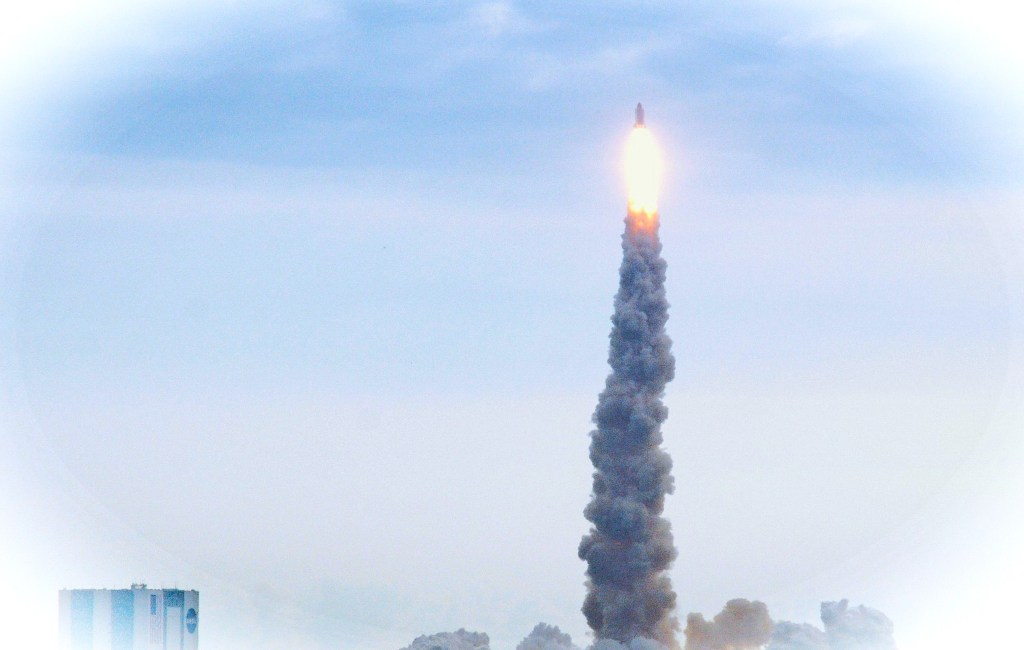
measuring your life across the reaches of space, puts so much into perspective
As the reusable NASA spacecraft, Artemis II, performed a lunar fly-by whilst setting a record for the farthest distance travelled from Earth, the world watched with one eye on the mission and the other on the irony of people dying by the same physics of jet propulsion. Indeed, as the rich and powerful vie for authority, superiority and a little less comity, it’s as well to note how we’re all standing on the same plane in some respects while not at all in others. It’s neither new nor news where we need oxygen, nutrition and some social interaction, yet, keeping it simple seems the hardest thing to do. In itself, it becomes easier if we ignore all the angles, as if zero-sum-ism is the be all and end-ism, but what if we all had the same take on our condition? What if, we could see who we are through the filter of distance?
On Thursday 12th September 2024, the first ever private sector space walk took place hundreds of miles above the Earth’s surface as successful entrepreneur, Jared Isaacman, commanded a crew of four to the inner reaches of the Van Allen Radiation Belts, before descending to a height of some 460 miles. Then, as he took his first steps through the capsule hatch, he met with the stunning sight of our home planet where beyond the exclusive club of 600+ professional astronauts who’d made the journey before him: the rest of us can only imagine.
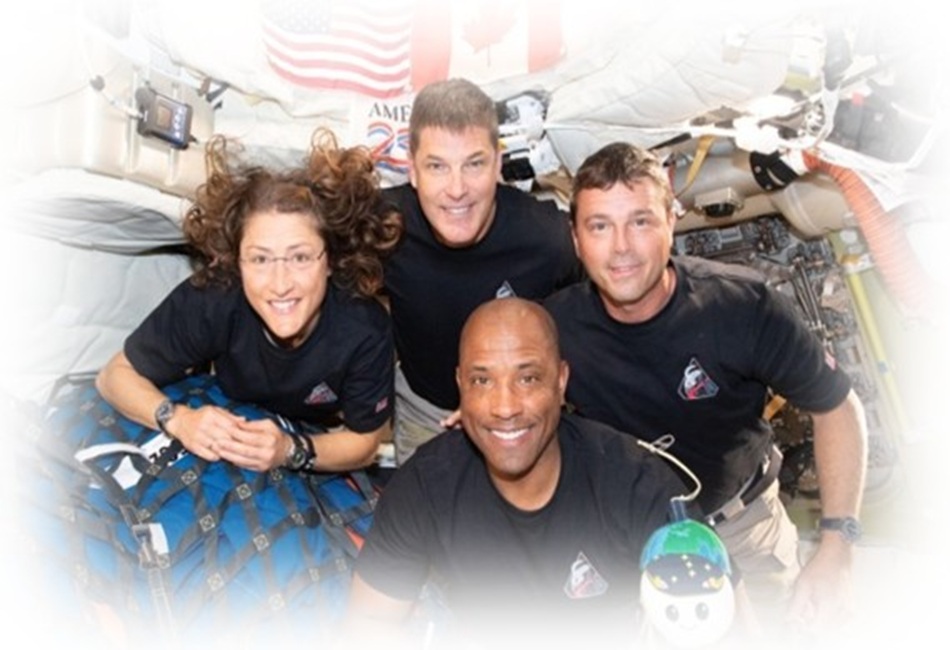
The crew of Artemis II; April 2026
We can only invent that singular moment when having formed degrees of understanding with the laws of physics as we know them, suddenly, a wide-lens view of the planet shatters everything known to our schemas. It is, without doubt, a moment in looking across the void of space at the spinning rock on which all else prevails for us. All of the history, wonder and beauty in evolutionary processes as cells divide and organisms grow while nature tries to balance itself with the weight of our greed and ignorance to boot. That segues neatly into the ugly, too, as our need to survive overwhelms benevolence, and war and death fit snugly behind a thumb.
As it happens, the Space X crew were too close to hide all our frailties, but still, with Earth’s enormity draped before them it inspired a decent quote from the intrepid Commander:
‘Back at home we have a lot of work to do, but from here – looks like a perfect world.’
Jared Isaacson
Whether rehearsed beforehand, en-route or off-the-cuff, it was worthy as he summed up a contradiction of contradictions. Indeed, with the silence of a vacuum befitting a soundtrack, the chaos of Earth and an existential absurdity may have seemed fresh while peculiarly stale. It’s a trend within a privilege on seeing the Earth from such a great height and ‘The Overview Effect’ goes back to the seventies. Coined by Frank White, an author and philosopher who interviewed astronauts, it describes quite neatly how those who’ve travelled at escape velocity, later see the world as never before.
‘And again, for most astronauts, the feeling that the Earth itself is awe (sic) whole system, and we’re just part of it. We need to think of ourselves as part of this organic system, if you will. And then there are other things that come out of it that is kind of the conclusion they draw. I mean, those are things they see, and then there are conclusions they draw. And one of them is that we are all in this together. Our fate is bound up with people that we may think are really different. We may have different religions we may have different politics. But ultimately, we are connected.’
Frank White on the NASA podcast, ‘The Overview Effect: Houston We Have a Podcast’ Season 1, Episode 107, Para 12
This is precisely and predictably the point.
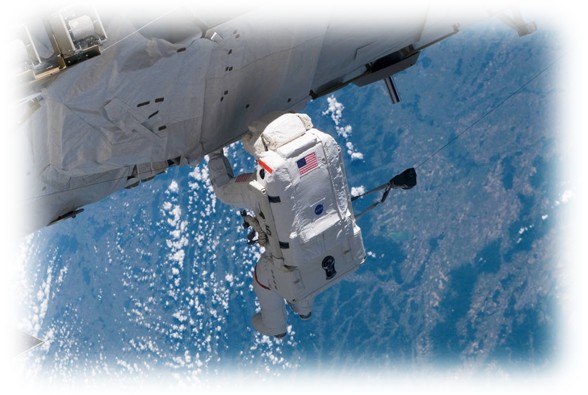
The International Space Station; March 2008
So, imagine for just a moment that one-by-one, each and every world leader regardless of political persuasion is strapped into the capsule of a rocket and projected through the sky at an escape velocity of 11.19-kilometres-per-second or 25,000 mph. As they reach orbital speed and turn to gaze through windows at what looks like a canvas painting of the Earth, waves of belief revision might overwhelm their senses. In fact, ideas of insularity begin to look weak against the singularity of a planet and the backdrop of infinity. Yet along with so many of us they may have initially rolled their eyes and scoffed in weighing up the interconnectedness of life, even if politically it served the wrong purpose or worse still meant existential suicide. In line with that, knowing and seeing are two different things on so many levels and as Frank White, adds:
‘We’re totally connected with life. And everything relates to everything else. And out of that, also, is the realization again. You could know that, too. I mean, you could say, I know that. I know we’re all connected. I know our differences don’t matter that much. But again, it’s knowing it with the brain and not the heart. And so, the big, sort of, what would I call it, insight, about their [astronautical] experience is that it is an experience.’
Frank White on the NASA podcast, ‘The Overview Effect: Houston We Have a Podcast’ Season 1, Episode 107, Para 12
Absolutely, and such a profound moment would undoubtedly affect the attitudes of those in charge of our daily lives and to such an extent that previously held partisan thinking, might find itself in a cognitive shift. That’s supposition, of course, but the point seems valid where space travellers have been irrevocably changed, by the sight of our planet from above. Still, if anything, it represents the problem with ourselves and the human condition writ large, as in the short-termism of humanism. So, let’s just imagine, once again, and at a point in time where important decisions are made from on high: neither euphemistically nor physically and with real leaders and their choices to make, thus affecting the lives of millions.
So, ignoring others could feel a lot harder with aerial geography and patterns of weather shared by us all and where suddenly, the plight of another falls into focus as cause and effect run rampant. The human condition is all about perspective from quarrels with neighbours to military campaigns and a worms-eye view of all types of injustice, keeps us from seeing the context at large. It’s the same with climate change and how we approach it while a herd of animals oblivious to danger might not see the cliff edge until it’s too late: meaning, corrective action depends on conditions that may or may not have changed.
‘A lot of people in our industry haven’t had very diverse experiences. So, they don’t have enough dots to connect, and they end up with very linear solutions without a broad perspective on the problem. The broader one’s understanding of the human experience, the better design we will have.’
Steve Jobs, former CEO of Apple Technology

When it comes to our mental health these principles remain the same because often, it’s hard to see the wider context of sadness, misery or outright depression while various circumstances overwhelm us. So, if only we could orbit ourselves in seeing the whole, it could help to frame a number of struggles and the ability to contain them, in one way or another. A stretch if you will across three score and ten, and where narratives spill more in a search for personal peace that now and again proves fruitless. Of course, it’s not always begrudgingly where life’s noise lies in the commitments you carry or possibly share and in the shape of children, a career or perhaps both. No, these are life-shapers in need of time, energy and inevitably, money, but also sources of peace by a different sort of measure.
It seems the answers are complicated by many things starting with these environments in your life. So, your inner state, home vibe and the socioeconomics may not align leaving levels of conflict possible or maybe inevitable, but then, it’s your awareness that ultimately counts. Even so, how you get there is another story and one with your decision-making in tow, while the narrative itself either flags or deceives you as it settles in for the ride. Well, we’ve all been there in going over the edge or skidding to a halt, but what puts you in step with everyone else is that decision-making process, guiding your life. These are seconds in time that can upturn a world or cement footholds in supporting a move as the flailing or reaching translates into power. For sure, one way or another the truth will emerge with degrees of purchase and regardless of input if it even matters, and this is the fear we carry within as we try and pretend otherwise.
So, with intensity mirroring the slightest of margins, the costs and benefits of inner peace wrestle like snakes in the pit of a life, but the undercurrent of living can surprise just as much as it often predicts. In fact, whether a step is false differs from one mind and agenda to the next making our collective relationships with each other, constantly complex. Again, it’s an arc of learning that taps into our most basic feelings of love, fear and death and the huge investments we make in and against all three. Still, nothing rewarding is without exhaustion while the dynamics of survival excel, in slowly wearing us down.
‘Chaotic people often have chaotic lives, and I think they create that. But if you try and have an inner peace and a positive attitude, I think you attract that,’
Dame Imelda Staunton, English actress and singer
Yet, with another type of peace sitting quietly as the hush in your mind, what does it leave you thinking? For many of us, it’s a difficult place to reach initially as we try and tune out the surrounding noise, but the fact that so many people prefer calm and tranquillity to the chaos so often born of insecurity, tells a story in itself. In 2020, for instance, the global analytics and advisory firm, Gallup joined together with the Wellbeing for Planet Earth Foundation to create the Global Wellbeing Initiative (GWI). As a result, they began surveying more than 120,000 people and in 140 languages, to understand our relationship with balance and harmony. To this end, Gallup also polled adults in 122 countries to ask: how often their thoughts and feelings brought them a sense of peace. Then, between 2020 and 2023, Gallup carried out a comprehensive survey amongst 386,654 people, in 145 countries, to understand the concept of ‘flourishing’ or thriving.
As you can imagine, variations exist in population samples, but what of a singular feeling of peace that has travelled beyond philosophies of East and West and more far flung, than anyone could imagine?

Many of us are too young to remember Apollo 11 and the 1969 moon landing as it gripped the world’s attention while in the brilliant film, Apollo 13: the incredible story of the crew’s emergency is retold in a suitably riveting fashion, alongside James Horner’s wonderful score. In fact, until the recent Artemis II mission, the Apollo crew held the record for the farthest distance travelled from the planet, but then as people on Earth looked up and they stared down, in 1970: these were moments apart, in our evolution as a species. Why? Because where we once stood naked in enthralment to the weather, the levers of power now sat on Earth and in Mission Control. What a journey.
Equally, as Michael Collins orbited the moon during Neil Armstrong and Buzz Aldrin’s lunar walk in 1969, he experienced something no less stunning and arguably perhaps, the most philosophical event in Earth’s history. You see, in line with six other astronauts on other missions, he alone ran system checks and communicated with mission control from the command module and for just over 20-hours, but each time he passed to the far side of the moon for 48-minutes: communication was lost and he was temporarily and profoundly the most isolated human being in the universe – in assuming our lone existence. His colleagues on the moon were over 2,000 miles away and so to date: he holds second place for the distance record in that solo isolation, and it must be said, a unique type of personal peace.
Instead, it was Al Worden of Apollo 15 who orbited just 63 miles or 104 kilometres farther than Collins from the moon’s surface, and in 2014, he was interviewed by Richard Hollingham for BBC News.
RH: Wasn’t it lonely?
AW: There’s a thing about being alone and there’s a thing about being lonely, and they’re two different things. I was alone, but I was not lonely.
RH: You were a quarter of a million miles away from home, though.
AW: Yes, you’re a long way away, but the thing that impressed me about being in lunar orbit – particularly the times when I was by myself – was that every time I came round the backside of the moon, I got to a window where I could watch the Earthrise and that was phenomenal. And in addition to that, I got to look at the universe out there with a different perspective and in a very different way than anyone before.
RH: Did that not make you feel even smaller?
AW: Oh yeah, you want to feel insignificant? Go behind the Moon sometime. That’ll make you really feel like you’re nothing!
What a moment in the relatively short lifespan of any human being because to sit in the vastness of space with nothing else organic beyond food and waste, must be an incredible thing to process. Yet, as you look out through a window at the infinity around you, the eternal questions that have been asked since antiquity remain unanswered and stubbornly so. Perhaps, though, the creepy feeling of wondering if you’re being watched would up the ante in a different sort of mind, but then astronauts are trained to reason things out. It might not remove the question, of course, which is impossible to ignore for most people on Earth let alone when floating on the far side of the moon. In fact, it would certainly make a difference to political minds as the sheer insignificance of personal power on a far grander planetary scale, reflected the essence of what it means to be human. Indeed, the take on our changing climate might look different, too, in the absence of a sister or neighbouring world while the question of a god in whatever guise, continues to hide an answer. So, as the queries tap away, the notions of a personal and planetary peace collide in the bubble of an orbiting capsule.
In his memoir, Carrying the Fire, Michael Collins describes the moment with the literary elegance accompanying some as they travel through space:
‘I don’t mean to deny a feeling of solitude. It is there, reinforced by the fact that radio contact with the earth abruptly cuts off at the instant I disappear behind the moon. I am alone now, truly alone, and absolutely isolated from any known life. I am it. If a count were taken, the score would be three billion plus two over on the other side of the moon, and one plus God only knows what on this side of the moon. I feel this powerfully – not as fear or loneliness – but as awareness, anticipation, satisfaction, confidence, almost exultation. I like the feeling. Outside my window I can see stars – and that is all. Where I know the moon to be, there is simply a black void; the moon’s presence is defined solely by the absence of stars.’
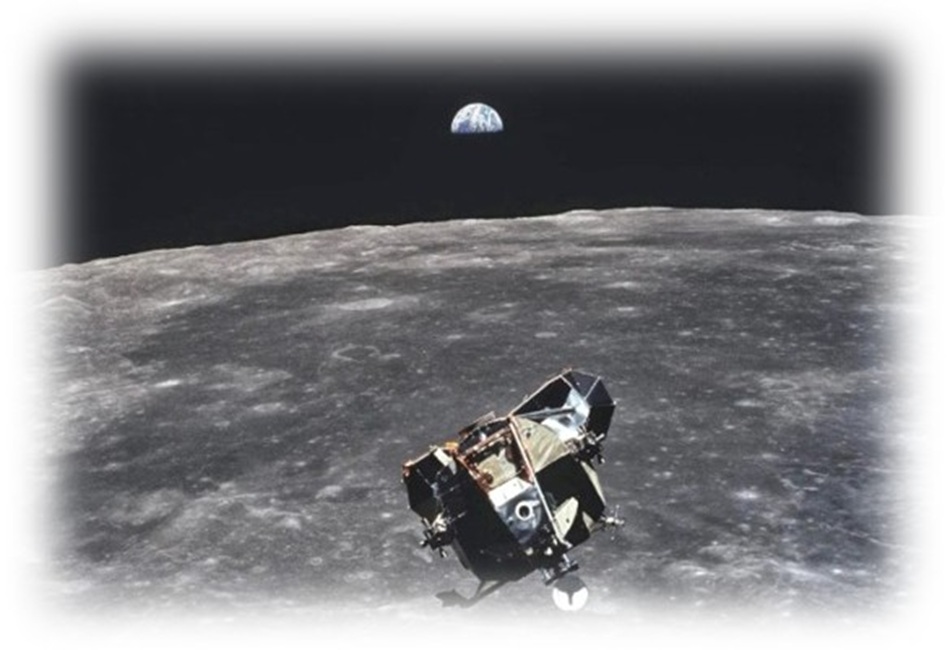
Michael Collins’ photograph of the lunar module and Earth
Surely, this is as beautiful and existential as it gets and yet, in visual terms, he took a photograph of such compelling significance that for many, it can only be regarded as one of the most important pictures ever taken if not, the most important. You see, as Armstrong and Aldrin left the surface of the moon in the lunar module, Collins waited in the command capsule and pointed a camera at his approaching colleagues. As he caught the lunar craft, the arc of the moon and planet Earth’s rise or descent into light or darkness roughly 400,000 kilometres away, he was the only person alive at that specific moment not to be represented in the photograph.
That is a story for the ages and so fittingly, the final word should go to Michael Collins:
‘I really believe that if the political leaders of the world could see their planet from a distance of, let’s say, 100,000 miles, their outlook could be fundamentally changed. That all-important border would be invisible, that noisy argument suddenly silenced. The tiny globe would continue to turn, serenely ignoring its subdivisions, presenting a unified façade that would cry out for unified understanding, for homogenous treatment. The earth must become as it appears: blue and white, not capitalist or communist; blue and white; not rich or poor; blue and white; not envious or envied. I am not a naïve man. I don’t believe that a glance from 100,000 miles out would cause a prime minister to scurry back to his parliament with a disarmament plan, but I do think it would plant a seed that ultimately could grow into such concrete action.’
Copyright © 2026 | recoveryourwellbeing.com | All Rights Reserved
Images
Blast Off, by Phyllis Lilienthal, Pexels – Main Image
NASA, 7th April 2026, The Artemis Crew, https://www.nasa.gov/blogs/missions/2026/04/08/artemis-ii-flight-day-8-crew-conducts-key-tests-on-return-to-earth/
NASA, 23rd March 2008, International Space Station Installation Day, https://www.nasa.gov/image-article/installation-day-international-space-station/
Meditation Men, by Edmond Dantes, Pexels, 8556605
Hands Together, by Ray Lei, Pexels, 2809836-13865894
Lakeside Rays, by Splitshire, 1402
NASA, 21st July 1969, Where is Michael Collins? Royal Museums Greenwich, https://www.rmg.co.uk/stories/space-astronomy/michael-collinss-space-photo
References
Dacia Massengill, Ed, ‘Artemis II Multimedia’, National Aeronautical Space Agency, Abigail Bowman, Responsible NASA Official, Last Updated: 9th April 2026, accessed 9th April 2026, https://www.nasa.gov/artemis-ii-multimedia/#images
Jessica Taveau, ‘NASA’s Artemis II Crew Eclipses Record for Farthest Human Spaceflight’, National Aeronautical Space Agency, Cheryl Warner, Ed, Abigail Bowman, Responsible NASA Official, Last Updated: 6th April 2026, accessed 9th April 2026, https://www.nasa.gov/news-release/nasas-artemis-ii-crew-eclipses-record-for-farthest-human-spaceflight/
‘Jared Isaacman’, Profile, Forbes Magazine, 10th November 2024, accessed 7th April 2025, https://www.forbes.com/profile/jared-isaacman/
C. Carreau, ‘Earth’s Plasmasphere and the Van Allen Belts’, European Space Agency, ESA, 10th September 2013, accessed 7th April 2025, https://sci.esa.int/web/cluster/-/52831-earth-plasmasphere-and-the-van-allen-belts#:~:text=The%20inner%20Van%20Allen%20belt,4%20to%207%20RE).
Zoe Hobbs, ‘How Many People Have Gone To Space?’, Astronomy Magazine, 8th November 2023, Para 2, accessed 7th April 2025, https://www.astronomy.com/space-exploration/how-many-people-have-gone-to-space/
‘Schema’, Britannica Online, 2024, accessed 7th April 2025, https://www.britannica.com/science/schema-cognition
Jackie Wattles, ‘’A Giant Leap’: Why a Tech Billionaire’s Climb Outside a Spacecraft Was So Historic’, CNN, 14th September 2024, Para 10, accessed 7th April 2025, https://edition.cnn.com/2024/09/14/science/spacex-polaris-dawn-spacewalk-historic-milestone/index.html
Frank White, ‘The Overview Effect: Space Exploration and Human Evolution (Florida, Multiverse Media Inc, 2023), accessed 7th April 2025, https://www.amazon.co.uk/Overview-Effect-Space-Exploration-Evolution/dp/B0C9H4KT2P/
Frank White.com, 2024, accessed 7th April 2025, https://frankwhiteauthor.com/
‘Escape Velocity Explained Neil deGrasse Tyson’, Youtube, 29th March 2023, accessed 7th April 2025, https://www.youtube.com/shorts/Jc3v6jyqIXw
Frank White Interview, Gary Jordan, ‘The Overview Effect’, NASA, Season 1, Episode 107, 30th August 2019, Para 15, accessed 7th April 2025, https://www.nasa.gov/podcasts/houston-we-have-a-podcast/the-overview-effect/
‘Orbital Velocity’, Britannica Online, 2024, accessed 7th April 2025, https://www.britannica.com/science/orbital-velocity
Rafael Rodrigues Testa, ‘Belief Revision in a Nutshell’, Principia an International Journal of Epistemology, 28(1):71-77, doi: 10.5007/1808-1711.2024.e96706, Introduction, accessed 9th April 2026, https://www.researchgate.net/publication/382166837_Belief_Revision_in_a_Nutshell
Frank White Interview, Gary Jordan, ‘The Overview Effect’, NASA, Season 1, Episode 107, 30th August 2019, Para 12, accessed 7th April 2025, https://www.nasa.gov/podcasts/houston-we-have-a-podcast/the-overview-effect/
‘Astronauts Describe Seeing Earth From Space’, ScienceAtNASA, 21st April 2021, accessed 7th April 2025, https://www.youtube.com/watch?v=iufG3-wrFHA
‘Down to Earth’ Series, NASA, 2024, accessed 7th April 2025, https://www.youtube.com/playlist?list=PLTXQuaxXBKKxEJ_zO8ou4cfmUPT8kgv5A
George H. Graham, ‘The Short-termism of Humanism’, Recover Your Wellbeing.com, accessed 9th April 2026, https://recoveryourwellbeing.com/2023/12/18/the-short-termism-of-humanism-2/
Steve Jobs Quote – ‘A lot of people…’, Brainy Quote, 2024, accessed 7th April 2025, https://www.brainyquote.com/quotes/steve_jobs_416912?src=t_perspective
Quote – Dame Imelda Staunton, ‘Chaotic people…’ Brainy Quote, 2026, accessed 9th April 2026, https://www.brainyquote.com/quotes/imelda_staunton_415815?src=t_inner_peace
Gallup, ‘Wellbeing for Planet Earth Foundation Seeks to Develop Globally Inclusive Understanding of Wellbeing’, 2026, https://www.gallup.com/analytics/358382/wellbeing-planet-earth-success-story.aspx
Kristjan Archer, ‘Who Feels Personal Peace on Earth?’ Gallup News, 22nd December 2022, accessed 9th April 2026, https://news.gallup.com/opinion/gallup/467315/feels-personal-peace-earth.aspx
Tim Lomas, et al, ‘A Multidimensional Assessment of Global Flourishing: Differential rankings of 145 Countries on 38 Wellbeing Indicators in the Gallup World Poll, with an Accompanying Factor Analysis of the Structure of Flourishing’, The Journal of Positive Psychology, June 2024, 20(3), doi: 10.1080/17439760.2024.2370538, accessed 9th April 2026, https://www.researchgate.net/publication/381829094_A_multidimensional_assessment_of_global_flourishing_Differential_rankings_of_145_Countries_on_38_wellbeing_indicators_in_the_Gallup_World_Poll_with_an_accompanying_factor_analysis_of_the_structure_of_#:~:text=We%20suggest%20that%20concepts,flourishing.
‘Apollo 13’, Imagine Entertainment & Universal City Studios, 22nd September 1995, IMDb, accessed 7th April 2025, https://www.imdb.com/title/tt0112384/
‘End Credits – James Horner – Apollo 13’, Youtube, James Horner Community, 21st March 2012, accessed 7th April 2025, https://www.youtube.com/watch?v=HLxNnas0Dck
Richard Hollingham, ‘Al Worden: ‘The Loneliest Human Being’ BBC News Features, 18th November 2014, accessed 9th April 2026, https://www.bbc.com/future/article/20130401-the-loneliest-human-being
Jon Clifton, ‘In Our Chaotic World, Can People Find Peace Within?’ Gallup News, 20th September 2023, accessed 9th April 2026, https://news.gallup.com/opinion/gallup/510797/chaotic-world-people-find-peace-within.aspx#:~:text=80%25%20always%20or%20often%20feel,aspects%20of%20their%20life%20are
Quote – Michael Collins, ‘Carrying The Fire’ (London, Pan; Main Market edition, 2019) Page 402, accessed 7th April 2025, https://www.amazon.co.uk/Carrying-Fire-Astronauts-Michael-Collins/dp/1509896570/
‘Michael Collins’ Space Photo’, Royal Museums Greenwich, 2024, accessed 7th April 2025, https://www.rmg.co.uk/stories/topics/michael-collins
Quote – Michael Collins, ‘Carrying The Fire’ (London, Pan; Main Market edition, 2019) Page 470, accessed 7th April 2025, https://www.amazon.co.uk/Carrying-Fire-Astronauts-Michael-Collins/dp/1509896570/

 recover your wellbeing